Open almost any Meta Ads account that’s underperforming and you’ll usually find the same root cause: the business is targeting cold strangers with the same intensity it should be reserving for people who already know the brand. It’s an easy mistake to make, and an expensive one to keep making month after month.
The fix isn’t a bigger budget or a flashier creative — it’s understanding the difference between two audience types that sit at the core of every well-run Meta campaign: custom audiences and lookalike audiences. Get this distinction right, and the same ad spend suddenly starts working a lot harder.
Custom Audiences: Talking to People Who Already Know You
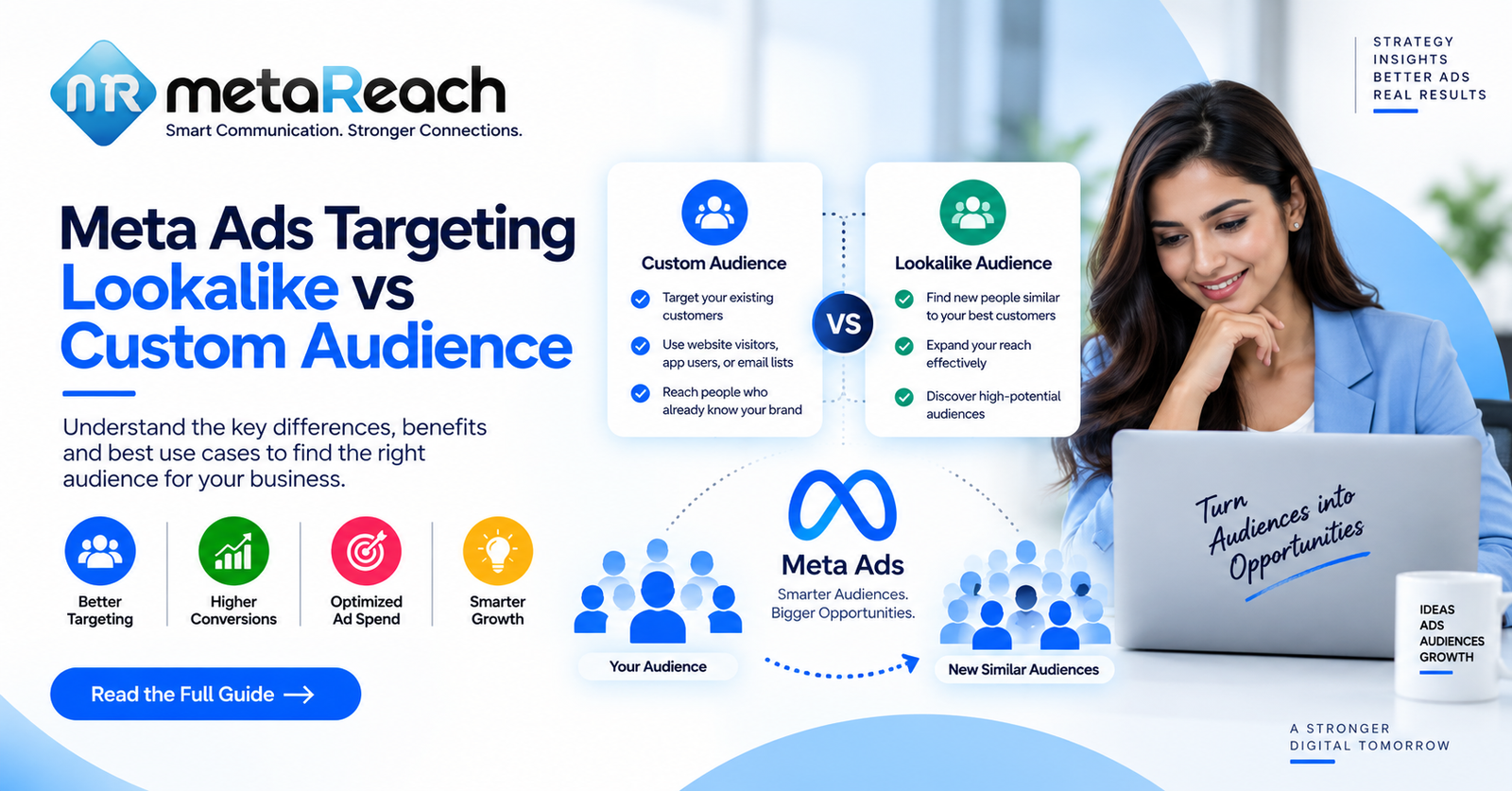
A custom audience is built from people who already have some connection to your business — website visitors who didn’t buy, past customers, email subscribers, or anyone who’s engaged with your Facebook or Instagram content. These are warm leads, not strangers, and that changes everything about how an ad should be written and priced.
Someone who browsed a product page last week and left without buying is far more likely to convert than someone who’s never heard of the brand. Showing up again with the right offer, at the right moment, is usually the cheapest and fastest way to recover sales that would otherwise be lost for good.
Lookalike Audiences: Finding More People Like Your Best Customers
A lookalike audience takes that same custom audience and uses it as a seed — Meta’s algorithm studies the shared traits of your existing customers and finds new people across Facebook and Instagram who match that profile. Upload a list of your best 1,000 buyers, and Meta can surface millions of people who share similar interests and behaviour.
This is how a business scales past its existing customer base without guessing who to target next. It’s slower to warm up than a custom audience, since these are people who don’t know the brand yet, but it’s the primary lever for genuine growth rather than repeatedly monetising the same small pool of existing contacts.
Why Running Only One of These Is a Half-Strategy
Businesses that rely only on custom audiences eventually plateau — there are only so many past visitors and buyers to retarget before the same faces keep seeing the same ads and fatigue sets in. On the other hand, businesses that pour their whole budget into lookalike audiences without a retargeting layer end up paying repeatedly to re-acquire attention they already earned once.
The strategy that consistently performs best pairs the two: lookalike audiences at the top of the funnel to bring in fresh, relevant traffic, and custom audiences further down to convert the people who engaged but didn’t buy on the first visit. Neither works as well in isolation as it does paired with the other.
A Quick Example of What This Looks Like in Practice
One clothing brand started with a simple custom audience of website visitors who hadn’t purchased yet. Once that campaign was converting well, they used the same audience as a seed for a 1% lookalike — Meta’s tightest similarity match — and used it to reach thousands of new, relevant users. The combination drove noticeably faster sales growth within a single month than either audience type would have managed alone.
The lesson isn’t that lookalikes are magic — it’s that quality seed data, paired with a disciplined retargeting layer, consistently beats guessing at broad, unstructured targeting. This is exactly the kind of structuring most self-managed Meta accounts skip, and it’s usually the single biggest reason two businesses with identical budgets get wildly different results.
Getting the Setup Right Matters More Than the Budget
A full breakdown of how to build and combine both audience types — including seed size recommendations, campaign sequencing, and real comparison data — is covered in this Meta Ads targeting guide on lookalike versus custom audiences, which walks through the practical setup step by step rather than just the theory.
If your Meta Ads spend has been climbing without a matching lift in sales, the underlying targeting structure is usually the first place to look — before touching the budget or the creative at all. Teams like MetaReach Marketing work with businesses across Noida and Delhi NCR to rebuild this exact layer of a campaign, pairing lookalike prospecting with custom-audience retargeting so ad spend stops leaking and starts compounding.
The Bottom Line
Meta Ads doesn’t reward bigger budgets nearly as much as it rewards better structure. Knowing when to retarget a warm lead and when to prospect for a new one — and building campaigns that do both at once — is usually the difference between an ad account that plateaus and one that keeps compounding month after month.