

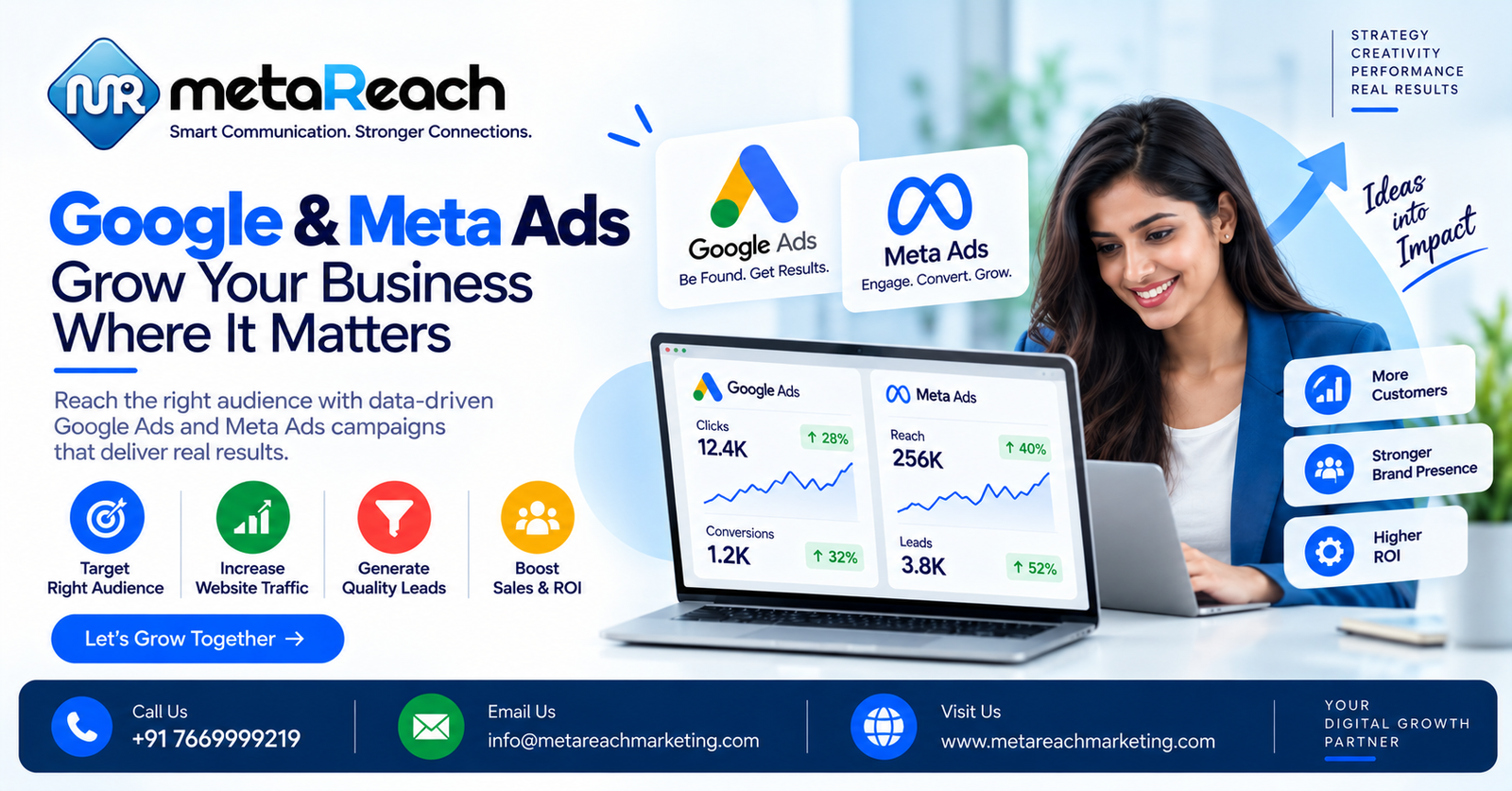
“Should I put my budget into Google Ads or Facebook and Instagram?” is probably the single most common question business owners ask before they’ve spent a rupee on paid advertising. It feels like a reasonable question. It’s also, more often than not, the wrong one to be asking first.
The two platforms aren’t really competing for the same job. They solve different problems at different points in a customer’s decision-making process, and treating them as interchangeable options — pick one, ignore the other — is usually how ad budgets end up quietly underperforming.
Google Ads Catches People Who Already Decided to Look
When someone types “dentist near Sector 62” or “coaching institute for NEET in Noida” into Google, they’re not casually browsing — they’ve already decided they need something and are actively looking for who can provide it. That’s about as high-intent as advertising gets, and it’s exactly why Google Search campaigns tend to convert faster and more reliably than almost any other channel.
The catch is that this intent has to be met instantly. If your ad isn’t showing with the right message at that exact search moment, the lead doesn’t wait around — it goes straight to whichever competitor did show up. Speed and relevance matter more here than almost any other variable.
Meta Ads Build the Demand Before Someone Starts Searching
Facebook and Instagram work on a completely different logic. Nobody opens Instagram planning to buy a flat or sign up for a gym membership — they’re scrolling for entertainment, and an ad has to interrupt that scroll with something genuinely interesting enough to stop for. This is a colder, earlier stage of the journey, but it’s also where a huge share of future search demand actually gets created.
Meta’s targeting depth is what makes this workable at scale — interests, behaviours, life events, lookalike audiences built from your best existing customers. A real estate launch, a fashion label, or a D2C brand can build genuine familiarity with exactly the right people, long before those people ever type a search query.
Why Picking Just One Usually Leaves Money on the Table
A business running only Google Ads is entirely dependent on people who already know what they want — which caps growth to existing demand rather than creating new demand. A business running only Meta Ads often builds awareness and interest that quietly leaks away, because there’s no search campaign waiting to catch that same person once they’re ready to act a few days later.
The businesses that consistently get the best return tend to run both together — Meta Ads to build familiarity and warm up cold traffic, Google Ads to capture that same audience the moment they’re ready to convert. It’s less about choosing a winner and more about understanding which platform does which job.
What Actually Separates a Good Campaign from a Budget Drain
Plenty of businesses have tried both platforms and still gotten burned — not because the channels don’t work, but because the setup underneath them was weak. Loosely themed ad groups, generic creative that blends into the feed, no retargeting layer to catch people who engaged but didn’t convert, and reports so vague they don’t actually explain what’s working.
A properly structured Google Ads and Meta Ads campaign setup fixes exactly these gaps — tight keyword-to-ad-group matching, landing pages that actually match the ad’s promise, layered retargeting across both platforms, and conversion tracking that shows real leads and sales, not just impressions and reach.
A Practical Way to Think About Budget Split
There’s no universal formula, but a reasonable starting point is to lean toward Google Ads for services people actively search for — clinics, legal help, coaching, local repairs — and toward Meta Ads for visually driven purchases like fashion, real estate launches, or new D2C products where discovery happens before intent does. Most real businesses end up somewhere in between, adjusting the split as data comes in rather than guessing upfront.
It also helps to track the two channels together rather than in separate silos. A lead that first saw a brand on Instagram and later converted through a Google search is still one customer journey, not two unrelated wins — and reporting that treats them as disconnected tends to undercount exactly the campaigns that are quietly doing the heavy lifting of building demand in the first place.
Agencies that specialise in this combination, like MetaReach Marketing, tend to look at industry-specific cost-per-lead benchmarks before recommending a split, rather than applying the same 50-50 formula to every client regardless of what they actually sell.
The Bottom Line
The real question isn’t Google versus Meta — it’s understanding where your customer actually is in their decision process, and building a campaign structure that meets them there. Businesses that stop debating which single platform to bet on, and instead build both into one coordinated funnel, are the ones who consistently turn ad spend into predictable, scalable growth instead of a monthly gamble.


