

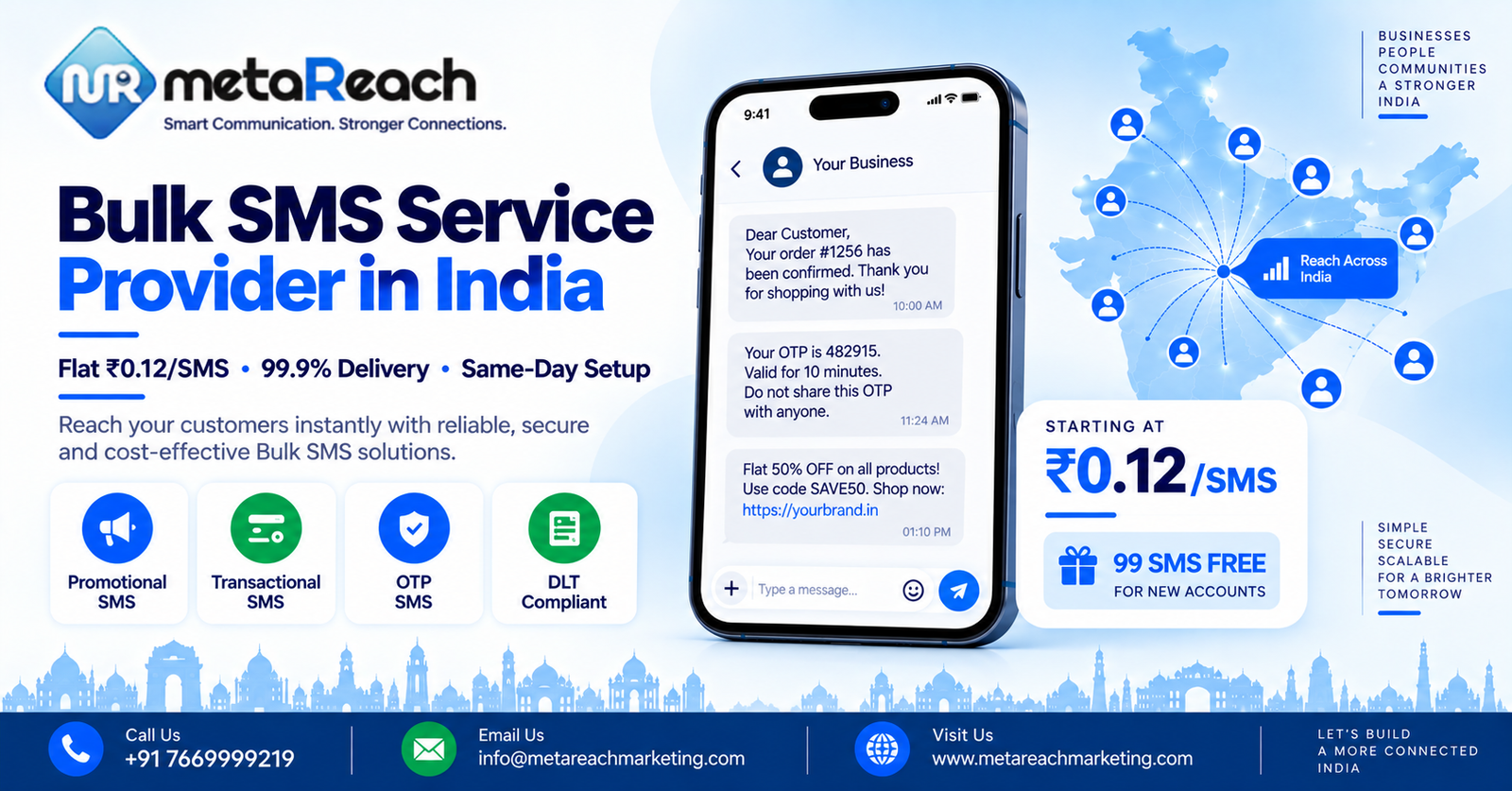
It’s easy to assume SMS is a relic in a world of push notifications, WhatsApp broadcasts, and algorithm-driven social feeds. And yet, when a business genuinely needs a message read within minutes — an OTP, a delivery update, a time-sensitive offer — SMS is still the channel almost nobody ignores.
The numbers back this up in a way few other channels can match. Text messages in India are typically opened within minutes of arriving, with open rates well above what email or social posts manage on their best day. No app needs to be installed, no internet connection is required to receive it, and there’s no algorithm deciding whether the message is worth showing.
Why This Still Matters in 2026
Every year there’s a new prediction that SMS is about to become obsolete, and every year it keeps quietly doing the job other channels can’t. Email gets buried in a crowded inbox. Push notifications get silenced the moment a user disables them. Social posts compete with an entire feed of distractions. A text message, on the other hand, lands directly on a screen with nothing standing between the sender and the recipient.
For time-sensitive information specifically — a one-time password, a payment confirmation, a delivery update, an appointment reminder — that directness isn’t a nice-to-have, it’s the entire point. A customer who’s waiting for an OTP to complete a payment isn’t going to check their email; they’re staring at their phone’s message screen.
Where Most Businesses Get the Strategy Wrong
The most common mistake isn’t choosing the wrong channel — it’s treating every text the same way. A promotional offer and an OTP have completely different urgency, timing rules, and compliance requirements in India, and businesses that send them through the same generic setup often end up with poor delivery rates or, worse, messages that violate TRAI’s DND regulations without realising it.
Getting this right means understanding the difference between transactional messages, which can be sent any time of day and bypass DND restrictions because they carry essential account or order information, and promotional messages, which are restricted to specific hours and only reach opted-in numbers. Businesses that mix these up either waste money on undeliverable sends or accidentally step outside compliance.
DLT Compliance Isn’t Optional — But It Shouldn’t Be a Headache Either
Since TRAI made DLT (Distributed Ledger Technology) registration mandatory for bulk messaging in India, a huge number of businesses have found themselves stuck navigating an unfamiliar government portal, unsure whether their sender ID or message template will actually get approved. Without this registration, messages simply don’t deliver at all, regardless of how good the campaign looks on paper.
This is exactly the kind of setup work that a properly structured bulk SMS service should handle end-to-end — entity registration, sender header approval, and template sign-off — so a business doesn’t need to become an expert in TRAI compliance just to send a delivery confirmation.
What Actually Separates a Reliable Provider from a Risky One
Not all bulk SMS platforms are built the same way. Some route messages through a chain of resellers before they ever reach a telecom network, which quietly degrades delivery speed and reliability, especially during high-traffic periods like festive sales or exam result days when everyone is sending at once. Direct carrier connections, on the other hand, tend to hold up under exactly that kind of pressure.
It’s worth asking any provider a few direct questions before committing: Is pricing genuinely flat across promotional, transactional, and OTP messages, or does it quietly jump for certain categories? Is DLT setup actually included, or a paid add-on disguised as a courtesy? And is delivery routed directly through major carriers, or bounced through multiple intermediary layers that each add latency and risk?
SMS Works Even Better as Part of a Bigger System
SMS doesn’t have to compete with WhatsApp, RCS, or voice — it works best alongside them. An OTP might go out over SMS for universal reachability, while a promotional campaign runs richer, more visual content through WhatsApp for customers who’ve opted in there. Treating these as one coordinated messaging strategy, rather than separate, disconnected tools, is what actually keeps customers informed without overwhelming them.
Platforms like MetaReach Marketing have built their approach around exactly this kind of consolidation — SMS, WhatsApp, RCS, and voice managed from one dashboard, backed by direct carrier connections and full DLT compliance handled on the business’s behalf, so reaching customers reliably doesn’t require juggling five separate vendors.
The Bottom Line
SMS isn’t glamorous, and it never trends the way a viral social post might. But for the messages that actually matter — the ones a customer needs to see right now — it remains one of the most reliable channels a business has. Getting the compliance, routing, and message-type strategy right isn’t complicated once it’s set up properly; it just needs to be done once, correctly, instead of patched together campaign by campaign.


