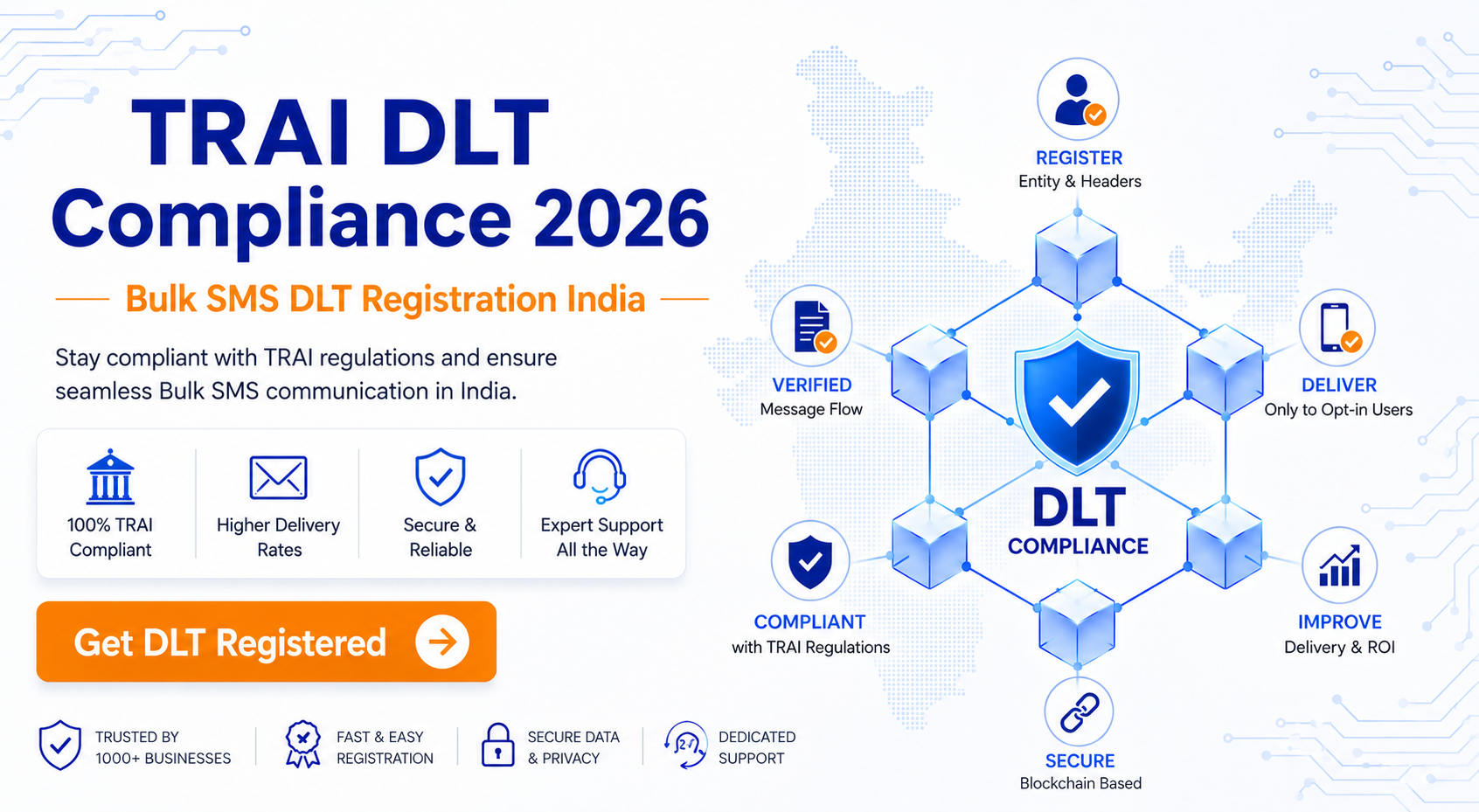
If your business sends bulk SMS in India and you have not completed DLT registration India, here is a reality check: your messages are being silently blocked. No error. No notification. No refund. The customer simply never receives the text, and you have no idea why. Whether you are sending order confirmations, OTP codes, or promotional offers, the TRAI DLT framework applies to every business, every message, and every sender ID across every telecom operator in the country.
This article breaks down TRAI DLT compliance in plain language — what it means, why it was introduced, how registration works, and what happens when you get it wrong. For the full technical guide with checklists and template examples, visit the official MetaReach resource: TRAI & DLT Compliance Guide India 2026.
The Three Steps of Bulk SMS DLT Registration
Completing bulk SMS DLT registration means working through three sequential phases. Each builds on the previous one, and skipping any stage will leave your campaigns incomplete and undeliverable.
Step 1: Entity Registration
This is where you register your business on a TRAI-approved DLT portal — platforms like Jio, Videocon (Vi), Airtel, or BSNL all offer portals. You submit your GST certificate or business PAN, your company address proof, and an authorised signatory letter on company letterhead. Once approved, your business receives a unique Entity ID that anchors all future registrations.
Step 2: Sender ID (Header) Registration
Your sender ID is the name your customers see instead of a phone number — for example, MYBZNS or 581204. Each header must be linked to your Entity ID and assigned to a specific message category. Alphabetic headers like MYBZNS are used for transactional and service messages; numeric headers like 581204 are used for promotional campaigns. Approval typically takes one to two working days.
Step 3: Template Registration
Every unique message you send must be pre-approved as a template. The template uses fixed text with variable placeholders — written as {#var#} — for dynamic content like customer names, order numbers, or amounts. If your live message differs even by a single character from the approved template, the operator’s filter will reject it. TRAI’s 2025 update also requires a category suffix in every template so recipients can identify the message type immediately.
If this sounds like a lot to manage, that is because it is. MetaReach handles all three phases for clients through its dedicated DLT registration support service, with most businesses going live within five to seven working days.
Message Categories: The Detail That Trips Most Businesses
One of the most misunderstood aspects of TRAI DLT compliance is the message category system. TRAI recognises four categories, and choosing the wrong one is the most common reason a technically registered campaign still gets blocked.
Transactional SMS
Reserved almost exclusively for banks sending OTPs to customers during live transactions. This category can be delivered 24/7 with no DND restrictions, but most businesses are not eligible for it.
Service Implicit SMS
This is the correct category for the vast majority of business messages that look transactional — order updates, shipping alerts, appointment reminders, and account notifications sent to existing customers. No explicit opt-in is required because the customer relationship implies consent. Deliverable 24/7.
Service Explicit SMS
For service-related updates with a promotional flavour, sent to users who have explicitly opted in. Deliverable only between 10 AM and 9 PM.
Promotional SMS
For marketing campaigns, offers, discounts, and lead generation. Can only be sent between 10 AM and 9 PM. Cannot reach DND-registered numbers without explicit Digital Consent Acquisition (DCA) consent.
For businesses sending OTP verification codes, the category choice is especially critical. A misclassified OTP causes login failures and abandoned checkouts. Learn more about OTP-specific requirements on the MetaReach OTP SMS service page.
Separately, India’s Digital Personal Data Protection (DPDP) Act adds another layer of compliance. DPDP requires specific, granular, informed consent for marketing communications and applies alongside TRAI consent requirements. Businesses in fintech, healthcare, and e-commerce especially need to treat these as two separate compliance obligations, not one. Learn more on the MetaReach Marketing homepage about how DPDP intersects with your messaging strategy.
What Non-Compliance Actually Costs Your Business
The consequences of skipping or improperly completing DLT registration India are not just technical — they directly affect customer experience, revenue, and business reputation.
- Silent message blocking: Your SMS never arrives. No error is returned, and you may not notice for days while customers miss OTPs, order updates, and time-sensitive alerts.
- Header blacklisting: A single non-compliant send can disable your entire sender ID, taking down all campaigns running under that header.
- Financial penalties: Telecom operators can impose fines for repeated violations and suspend your sending privileges entirely.
- No audit trail: TRAI or operator queries about consent records and delivery logs cannot be answered, compounding any investigation.
- Customer trust damage: Blocked OTPs create failed logins. Missing order updates create support calls. Undelivered alerts create refunds. Each is a direct cost.
A Quick Pre-Send Compliance Checklist
Before every campaign, confirm these items are in place:
- Entity registered on a TRAI-approved DLT portal with KYC complete and credentials current
- Sender ID (header) approved and matched to the correct message category
- Every template pre-approved, with exact fixed text and correct variable placeholders
- Correct category assigned — Transactional / Service Implicit / Service Explicit / Promotional
- Consent records available for all promotional and service-explicit recipients
- DND status scrubbed against a current registry feed, with opt-outs honoured immediately
- Promotional campaigns scheduled strictly between 10 AM and 9 PM
- DPDP-level consent satisfied for marketing, separate from DLT consent
Whether you need bulk SMS services, promotional SMS campaigns, transactional SMS alerts, or WhatsApp Business API integration, MetaReach ensures the compliance layer is solid before the first message goes out.