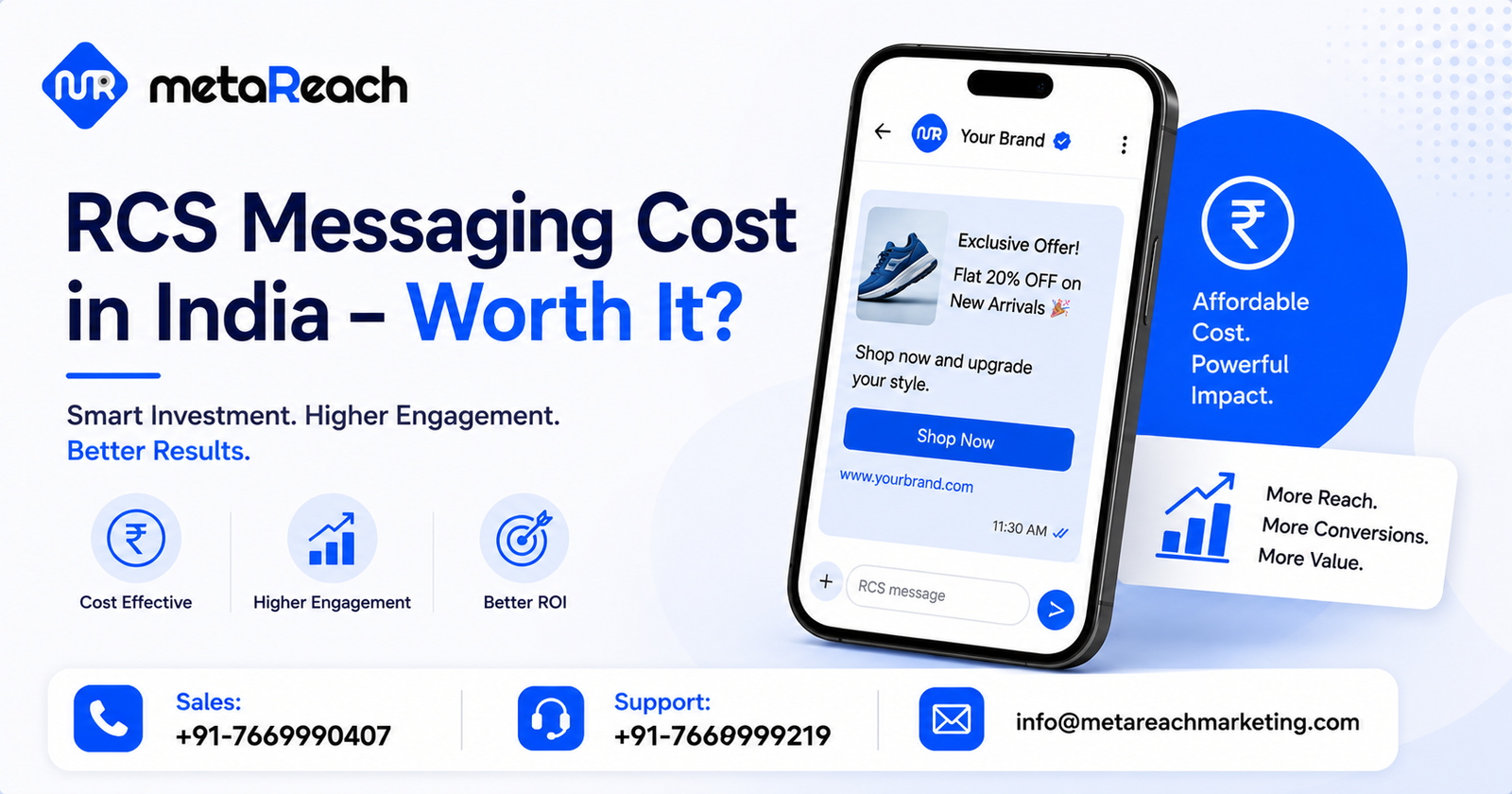
Every business evaluating RCS in India eventually asks the same question in slightly different words: is this actually worth paying more for? It’s a fair question, because on paper the answer looks obvious — RCS costs more per message than plain SMS, sometimes two or three times as much. But that comparison, taken on its own, misses the part that actually matters for a marketing budget.
The honest starting point is this: RCS is not cheap, and nobody should pretend otherwise. The real question isn’t whether it costs more per message. It’s whether it costs less per outcome — per booking, per sale, per resolved query. That’s a completely different calculation, and it’s the one most businesses skip.
Why RCS Pricing Looks Confusing at First
Unlike SMS, which has a fairly standard per-message rate across the market, RCS pricing in India isn’t uniform because there’s no single regulated tariff the way TRAI regulates SMS. Each telecom operator negotiates its own rate with Google, and the CPaaS providers who sell API access add their own margin on top. That’s why quotes for the same use case can vary meaningfully between providers — the underlying infrastructure is identical, but the pricing layer above it isn’t.
What businesses actually pay for typically falls into three buckets: a basic text-heavy message with a verified sender badge, a richer card format with images and tappable buttons, and a conversational session fee that covers an entire back-and-forth exchange rather than charging per individual message. Knowing which bucket a use case falls into — before requesting a quote — makes a real difference to the number that comes back.
The Metric That Actually Matters: Cost Per Outcome, Not Cost Per Message
Here’s where the RCS-versus-SMS comparison usually goes wrong. A plain SMS might cost a fraction of an RCS message, but if it takes three follow-up SMS reminders to get one customer to complete a purchase, the true cost of that conversion is three times the quoted rate. RCS, with tappable buttons and product carousels sitting inside the message itself, often needs fewer touches to get the same result — sometimes dramatically fewer.
That’s why businesses running cart-recovery campaigns, financial offer journeys, or guided onboarding flows tend to see the economics flip in RCS’s favour once they measure cost per conversion instead of cost per send. A one-way OTP alert, on the other hand, rarely needs any of that richness — plain SMS usually remains the more sensible choice there.
A Simple Filter Before Committing Budget
A useful test: does the message need the customer to do something — tap, choose, confirm, browse — or does it simply need to inform them? If it’s the former, RCS’s richer format tends to justify its premium. If it’s the latter, the extra cost is usually hard to defend, and SMS remains the more efficient channel.
For businesses trying to model this out before committing budget, a detailed breakdown of RCS messaging costs in India — covering per-message-type pricing, setup and platform fees, and a framework for estimating monthly spend — makes it much easier to build a realistic number instead of guessing from a single sales quote.
The Costs That Aren’t on the Rate Card
Beyond the per-message rate, two other costs tend to catch businesses off guard: a one-time fee to register and verify an RCS agent with Google, and sometimes a recurring platform subscription covering dashboards and analytics. Neither is usually large enough to change the underlying decision, but both should be factored into a first-quarter budget rather than discovered on an invoice later.
It’s also worth remembering that RCS doesn’t reach every device yet. A properly configured setup automatically falls back to SMS for recipients whose phone or network doesn’t support RCS, so the true cost of a campaign is really a blend of both channels rather than RCS pricing in isolation.
Where This Leaves Most Indian Businesses
In practice, the businesses getting real value from RCS in India aren’t abandoning SMS — they’re running both, with RCS reserved for the journeys where richer presentation genuinely changes customer behaviour, and SMS handling broad-reach, low-complexity notifications where cost efficiency matters more than engagement depth. That hybrid approach, rather than an all-or-nothing switch, is what tends to hold up once the pilot data comes in.
Meta Reach Marketing is a Noida-based communication agency that has helped businesses across India run SMS, RCS, and WhatsApp campaigns side by side for over a decade, with a focus on matching each message journey to the channel that actually delivers the best cost per outcome — not just the cheapest quote on paper.
Final Thought
RCS is not a cheaper version of SMS, and it was never meant to be. It’s a different tool for a different kind of message — one where a customer needs to act, not just read. Judged on the wrong metric, it looks like an unnecessary expense. Judged on cost per conversion, for the right use cases, it usually pays for the difference and then some.