Ask five different SMS providers in India what an OTP costs, and you’ll likely get five different answers wrapped in five different fine-print clauses. Some quote a low headline rate and then add setup fees, monthly minimums, or a lower price that only applies once a business hits a certain volume. For a founder or product manager evaluating options, this makes comparing providers far harder than it should be. Understanding what actually goes into OTP SMS pricing — and which extra charges are worth watching for — makes that comparison a lot easier.
Why OTP Pricing Looks Simple But Often Isn’t
On the surface, OTP SMS pricing is just a rupee amount per message. In practice, several other factors shape what a business actually ends up paying. Some providers charge a setup fee just to get an account provisioned. Others enforce a minimum monthly commitment, so a business with fluctuating or seasonal volume ends up paying for messages it never sends. A few charge extra for DLT (Distributed Ledger Technology) registration — the TRAI-mandated compliance step every commercial SMS sender in India must complete — treating what should be a standard part of onboarding as a separate line item.
What a Genuinely Transparent Rate Should Include
A fair OTP pricing structure has a few consistent traits. It should be billed only on successful delivery — a message that never reaches the recipient’s handset because the number was unreachable or the network failed shouldn’t cost the business anything. It should include DLT registration as part of onboarding rather than as a paid add-on, since this compliance step is mandatory regardless of provider. And it should scale cleanly with volume, without a business needing to renegotiate its entire contract just because it grew from a few hundred OTPs a day to a few thousand. Providers that build all of this into one flat, published rate make budgeting dramatically simpler than those hiding the real cost behind a sales call.
Delivery Speed Is Part of the Price Too
It’s tempting to compare OTP providers purely on rupees per message, but delivery speed and reliability are effectively part of the price as well. An OTP that takes fifteen seconds to arrive is, in a very real sense, more expensive than one that arrives in five seconds — because the slower one costs a business abandoned logins, failed checkouts, and support tickets that a faster route would have avoided entirely. Automatic failover to a backup carrier route when the primary one is congested, and 24/7 delivery that bypasses DND restrictions since OTPs are classified as transactional messages, are both features that directly affect the real cost of a failed verification, not just the cost of a sent one.
How Volume Should — and Shouldn’t — Affect Cost
Volume tiers make sense when they unlock genuinely better infrastructure — dedicated routes, SMPP connectivity for very high throughput, or a dedicated account manager for enterprise clients. What doesn’t make sense is a business paying a materially higher per-message rate simply because it hasn’t yet hit an arbitrary volume threshold. A well-structured pricing model keeps the per-OTP rate consistent across plan tiers and instead differentiates plans by features and support level — startup teams sending a few thousand OTPs a month shouldn’t be penalized on price just because they haven’t scaled yet.
Comparing Providers the Right Way
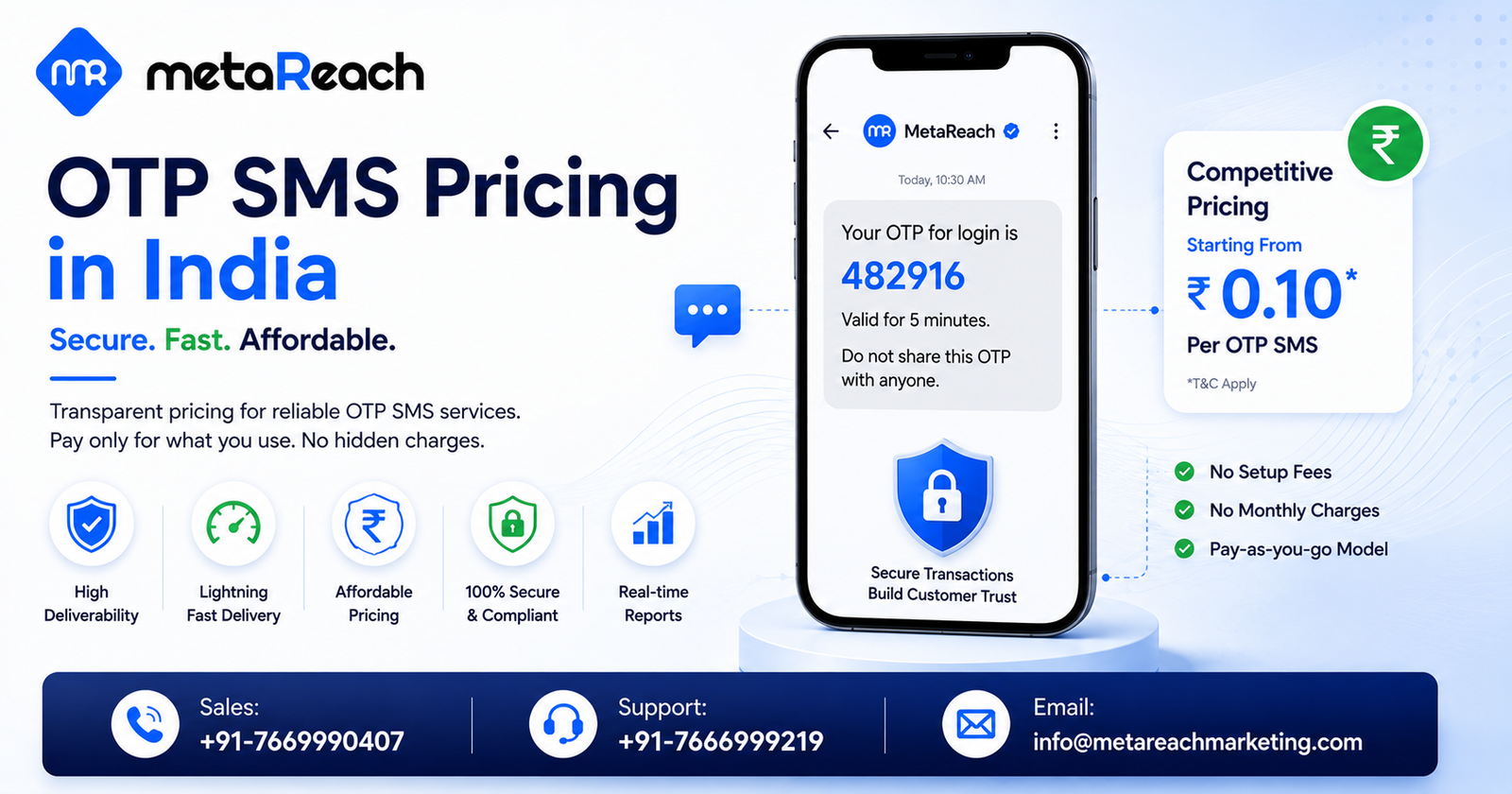
Rather than comparing headline rates alone, it helps to ask a provider directly: is DLT registration included or billed separately? Are failed or unanswered messages charged? Is there a minimum monthly commitment? What’s the average delivery time, and is there automatic failover if a route is congested? MetaReach Marketing’s OTP SMS pricing page lays out exactly this kind of detail — a flat, published per-OTP rate with DLT registration included, no setup fees, and billing only on successful delivery, which makes it a useful reference point for what transparent OTP pricing in India should actually look like.
It’s also worth factoring in what happens when something goes wrong. A provider’s real-time dashboard — showing delivery status, failure reasons, and per-message tracking — matters more than it seems during a busy launch or a payment gateway incident, when a support team needs to diagnose an OTP problem in minutes rather than hours. Providers that hide this level of detail behind a vague “delivered” status make troubleshooting far harder than it needs to be, and that hidden cost rarely shows up on a pricing page.
The Bottom Line
OTP SMS might look like a small line item in a company’s overall communication budget, but a poorly chosen provider can quietly cost far more than the per-message rate suggests — through failed verifications, hidden fees, and support that doesn’t scale with the business. Taking the time to understand what’s actually included in a quoted rate, rather than comparing numbers in isolation, is the difference between a pricing decision that holds up as a business grows and one that needs revisiting every few months.
Businesses looking to compare OTP SMS pricing against other communication channels — Bulk SMS, WhatsApp Business API, or Voice OTP — can explore the full range of services offered by Meta Reach Marketing, a Noida-based enterprise communication agency trusted by 500+ businesses across India.