

Bulk SMS still quietly powers a huge share of everyday business communication in India. Order confirmations, OTPs, appointment reminders, festive offers, EMI alerts — nearly every one of these lands as a text message before anything else. Email gets ignored, app notifications get muted, but a text usually gets read within minutes. That reliability is exactly why bulk SMS remains one of the cheapest, highest-open-rate marketing channels a business can use, even in a year dominated by WhatsApp and app-based messaging.
What trips up most first-time buyers isn’t whether to use SMS — it’s understanding what it actually costs. Quoted per-SMS rates rarely tell the whole story, and the fine print is where budgets quietly blow out.
Why the Headline Rate Isn’t the Whole Picture
Almost every provider in India will quote a rate somewhere between ₹0.10 and ₹0.17 per SMS. On paper, that gap looks small. In practice, a business sending a few lakh messages a month can end up paying thousands of rupees more purely because of how the pricing is structured — tiered volume slabs, separate rates for promotional versus transactional traffic, and a DLT registration fee that many providers pass on as a separate line item.
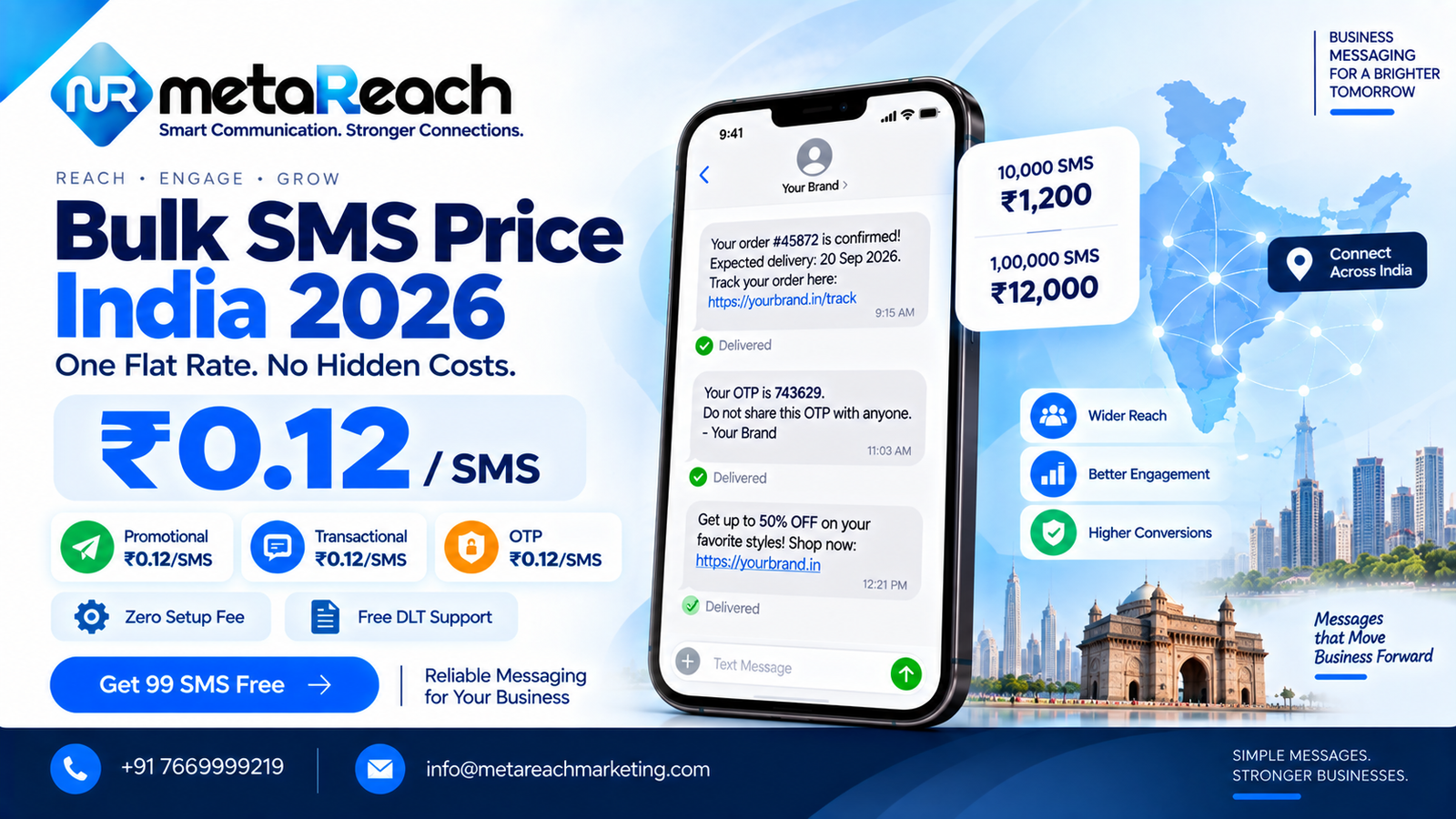
A closer look at a current bulk SMS price breakdown for India shows how this plays out. Rather than tiered slabs, a flat per-SMS rate applies whether a business sends ten thousand messages or five lakh, and the same rate covers promotional, transactional, and OTP traffic. That kind of pricing structure is easier to budget against because there’s no threshold to cross before the rate improves — the number you’re quoted on day one is the number you pay at scale.
The DLT Fee Nobody Explains Clearly
Every commercial SMS sender in India is required to register on TRAI’s Distributed Ledger Technology (DLT) platform before sending a single message. This isn’t optional and no provider can waive it — the telecom operator charges roughly ₹5,900 including GST for the registration itself.
Where providers genuinely differ is in what they charge on top of that mandatory fee. Many bulk SMS companies bill an additional ₹3,000 to ₹5,900 as a “service fee” for handling entity registration, sender ID setup, and template approval — work that, in reality, takes a support team a few hours to complete. For a business setting up SMS for the first time, that add-on fee can be larger than months of savings from a slightly lower per-SMS rate, which makes it worth asking upfront: does the quoted price include DLT handling, or is that billed separately?
Promotional vs Transactional: A Cost Distinction That Matters
Not all SMS traffic behaves the same way, and pricing sometimes reflects that. Promotional messages — offers, discounts, campaign blasts — are blocked on DND-registered numbers and restricted to a 9 AM–9 PM sending window under TRAI rules. Transactional and OTP messages, by contrast, are allowed 24/7 and reach DND numbers too, since they carry information the customer specifically requested, like an order update or a login code.
Some providers charge more for transactional and OTP routes because they run on priority delivery paths with sub-five-second latency. Whether that premium is justified depends on the use case — a bank sending login OTPs genuinely needs that speed, while a retailer blasting a weekend sale probably doesn’t need to pay for it.
A Quick Way to Estimate Real Monthly Cost
For budgeting purposes, a simple back-of-envelope approach works reasonably well: multiply expected monthly SMS volume by the quoted per-SMS rate, add 18% GST, then add the one-time DLT fee only in month one. A retail business sending roughly 80,000 transactional and 40,000 promotional messages a month, for instance, is looking at a fairly modest five-figure monthly spend at typical current rates — a fraction of what equivalent reach would cost through paid social or print advertising.
What to Ask Before Signing Up
A few questions tend to separate a transparent SMS provider from one with hidden costs: Is the per-SMS rate flat across volumes, or does it change at certain thresholds? Is DLT registration included, or billed separately? Is there a setup fee or monthly minimum? And does the quoted rate apply equally to promotional, transactional, and OTP traffic, or only to one category?
Getting straight answers to those questions upfront — rather than discovering them on the first invoice — is usually the difference between a smooth rollout and a budget surprise. Providers like MetaReach Marketing publish this kind of pricing detail openly, including DLT and setup costs, specifically so businesses can compare on equal footing before committing to a volume or a contract.
The Bottom Line
Bulk SMS remains one of the most cost-effective ways to reach customers in India, but the real cost only becomes clear once volume tiers, DLT fees, and message-type pricing are accounted for together — not just the headline per-SMS rate. Businesses that ask the right questions before onboarding tend to avoid the surprise charges that quietly inflate a first-year messaging budget, and end up with a clearer, more predictable line item to plan around.


