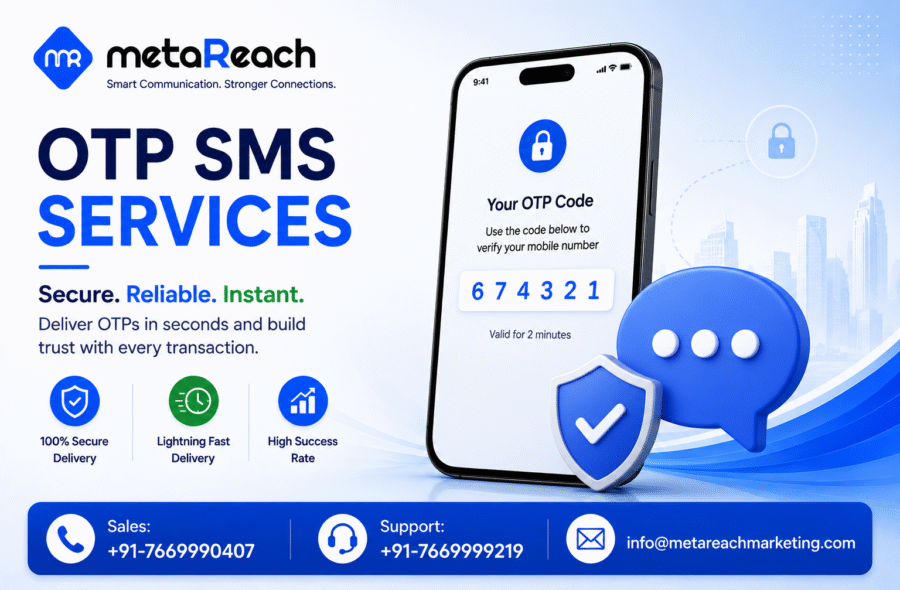
Every time someone logs into a banking app, completes a checkout, or resets a password in India, there’s a good chance a one-time password just landed on their phone. It’s such a routine part of digital life that most people never think about what’s happening behind that six-digit code — or how much a business’s growth can depend on that message arriving in under five seconds instead of thirty.
That gap between instant and delayed matters more than it sounds. A user who doesn’t get their OTP quickly assumes something’s broken. They retry, they get frustrated, and a meaningful percentage simply abandon the signup or the purchase altogether. For businesses running on thin conversion margins — fintech apps, e-commerce checkouts, healthcare portals — that lost user isn’t a minor inconvenience. It’s a lost customer.
Why OTP Verification Still Wins Over Alternatives
There’s no shortage of authentication methods available today — authenticator apps, biometric logins, email links. But SMS-based OTP remains the most universally reliable option in the Indian market for one simple reason: it works on every phone, on every network, with or without an internet connection. A feature phone user in a small town and a smartphone user in a metro city both receive the same message the same way. No app to install, no extra setup, no dependency on data connectivity.
This is also why OTP SMS remains the backbone of two-factor authentication across Indian banking, fintech, and e-commerce. It adds a layer of security that static passwords simply can’t match — a code that’s generated fresh, expires quickly, and can’t be reused, blocking most account-takeover attempts before they even start.
The Part Most Businesses Underestimate: Delivery Infrastructure
Not all OTP delivery is built the same way, and this is where a lot of businesses run into trouble without realising it. Many SMS providers route OTPs through the same queues as promotional traffic, which means an authentication message can get stuck behind a marketing blast during peak hours — exactly when speed matters most. Providers that keep dedicated, transactional-only routes with direct carrier connections avoid this bottleneck entirely, and the difference shows up in delivery time: often the gap between two seconds and fifteen.
Compliance is the other piece that trips businesses up. In India, TRAI’s DLT (Distributed Ledger Technology) framework requires entity registration, sender ID approval, and template approval before any commercial SMS — including OTPs — can be sent. Skip this and messages simply don’t get delivered, regardless of how good the underlying platform is. Businesses evaluating providers should always confirm this is handled properly, since a botched DLT setup is one of the most common — and most avoidable — reasons OTPs fail to land.
What a Reliable OTP Setup Actually Looks Like
For businesses building or scaling a verification flow, a few things separate a genuinely reliable setup from a risky one: dedicated transactional routes that never share bandwidth with bulk promotional traffic, sub-six-second average delivery across all major carriers, and a fallback channel — usually voice OTP — that kicks in automatically if the SMS doesn’t land. A well-built system for OTP SMS services covers exactly this — direct SMPP connections to Jio, Airtel, Vi, and BSNL, DND-exempt transactional routing since OTPs are classified as essential rather than promotional messages, and DLT registration handled end-to-end so businesses don’t get stuck navigating TRAI’s portal on their own.
Integration speed matters too. A clean REST API with clear documentation and ready-made code samples means most development teams can go from signup to sending live OTPs in under half an hour, rather than losing days to a clunky integration process.
Choosing a Provider That Scales With You
The mistake many growing businesses make is picking an OTP provider suited to their current volume without checking whether that same infrastructure can handle ten times the load a year later. Migrating authentication providers mid-scale is disruptive and risky — it’s worth choosing a platform built to handle both a startup sending a few hundred OTPs a day and an enterprise sending millions a month, without requiring a system change in between.
It also helps to work with a provider that connects OTP delivery to the rest of a business’s communication stack — transactional SMS, WhatsApp Business API, voice fallback, and bulk messaging — rather than juggling separate vendors for each channel. MetaReach Marketing operates on exactly this model, running OTP, transactional SMS, WhatsApp, and RCS messaging under one account, with DLT compliance handled centrally — giving businesses a single accountable partner for the entire authentication and communication layer instead of five separate ones.
The Bottom Line for 2026
As digital transactions in India keep growing — across banking, fintech, healthcare, and e-commerce — the businesses that treat OTP delivery as a critical piece of infrastructure, not an afterthought, are the ones that protect their conversion rates and their users’ trust at the same time. A slow or unreliable OTP doesn’t just cost a single transaction; it quietly erodes confidence in the platform every time it happens.
The fix isn’t complicated. It starts with picking a provider that treats speed, compliance, and fallback delivery as non-negotiable basics rather than premium add-ons — and then getting the integration right the first time, so it’s one less thing to worry about as the business scales.