A user opens your app, enters their number, and waits. Three seconds pass. Then six. Then ten. By the time the OTP finally lands, half of them have already closed the app and moved on to a competitor that didn’t make them wait. This single moment, the gap between requesting a code and receiving it, is one of the most underrated points of failure in any digital product, and most teams only notice it after their conversion numbers start slipping.
It’s easy to assume all OTP delivery is basically the same, since every provider promises ‘instant’ delivery on their homepage. In practice, the routing infrastructure behind that promise varies enormously, and it’s the difference between a code that arrives in under six seconds and one that shows up a full minute later, if it shows up at all.
Why OTPs Fail More Often Than You’d Think
The most common reason an OTP arrives late isn’t a network outage, it’s queuing. Many SMS providers route authentication messages through the same pipes as bulk promotional traffic. When a marketing blast goes out to a few lakh numbers at the same moment your user is trying to log in, that OTP sits in a queue behind thousands of promotional texts. The user never sees the backend explanation; they just see a login that doesn’t work.
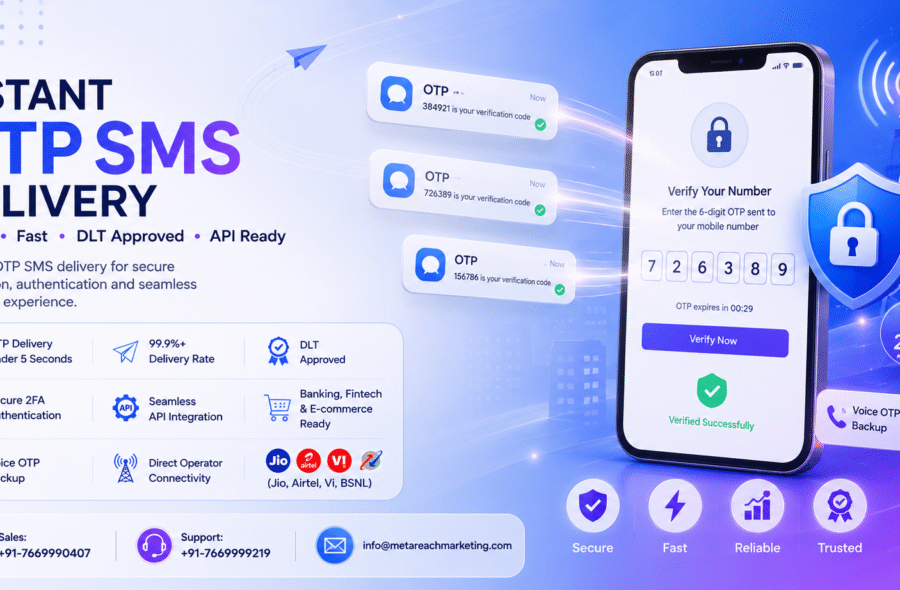
A properly built OTP gateway keeps these two traffic types on entirely separate routes, so a promotional campaign running in the background never has any chance of delaying a login or payment confirmation. This single architectural decision is often the real difference between providers, far more than anything advertised on a pricing page.
DLT Compliance Isn’t Optional, and It Isn’t Simple
Every business sending commercial SMS in India needs a TRAI DLT registration, covering entity registration, sender ID, and approved message templates. Skip a step here, and messages don’t get delivered at all, they get silently rejected by the operator. This is where a lot of in-house teams lose weeks, stuck between confusing portal screens and rejected template submissions.
A gateway that handles this registration on your behalf, rather than leaving you to figure out entity IDs and template wording alone, removes a genuine operational headache before you’ve sent a single OTP. Businesses evaluating a provider for this can review a full breakdown of how dedicated OTP SMS routing and DLT-compliant delivery work together on infrastructure built specifically for authentication traffic.
Why SMS Still Beats App-Based Authenticators for Reach
Authenticator apps are great until a user doesn’t have one installed, or is on a basic handset without app support. SMS OTP works everywhere: feature phones, 2G connections, every network operator, no additional download required from the user. For a country with hundreds of millions of users across wildly different device types, this universality is exactly why SMS remains the default second factor for banking, fintech, and e-commerce platforms rather than a legacy fallback.
That said, no channel is bulletproof. Handsets go out of coverage, numbers get temporarily unreachable, and networks occasionally drop packets. The platforms that handle this well don’t just retry the same SMS endlessly, they fail over automatically to a voice call that reads the code aloud, so a coverage gap never turns into a failed verification.
What Actually Matters When You Choose a Provider
Setup speed matters more than most teams initially budget for. A REST API with clean documentation and ready-made code samples should get a competent developer from signup to a working integration in well under an hour, not days of back-and-forth with support. If a provider’s onboarding process feels slow, that’s usually a preview of how their support will feel once you’re a paying customer with a production issue.
Pricing transparency is the second thing worth checking closely. Watch out for monthly minimums, setup fees buried in the fine print, or credit systems that expire before you’ve had a real chance to use them. A provider confident in their delivery rates doesn’t need to lock you into anything, pay-as-you-go pricing with volume discounts as you scale is the healthier model.
Reporting is the third piece that separates a mature provider from a basic reseller. Real-time delivery status, operator-level breakdowns, and specific failure reason codes let your team actually diagnose an issue instead of guessing. You can see how one Noida-based provider structures its full messaging stack, from OTP and transactional SMS to voice and WhatsApp, at MetaReach Marketing, which gives a useful reference point for what a complete authentication and communication setup looks like end to end.
The Bottom Line
OTP delivery is one of those parts of a product that users never think about when it works, and never forget when it doesn’t. A slow or failed OTP doesn’t just delay a login, it plants a small seed of doubt about whether your platform is reliable at all. Getting the infrastructure right behind the scenes, dedicated routing, proper DLT compliance, and a voice fallback for when SMS can’t get through, is a small investment that quietly protects a much bigger number: how many of your users actually make it past the login screen.