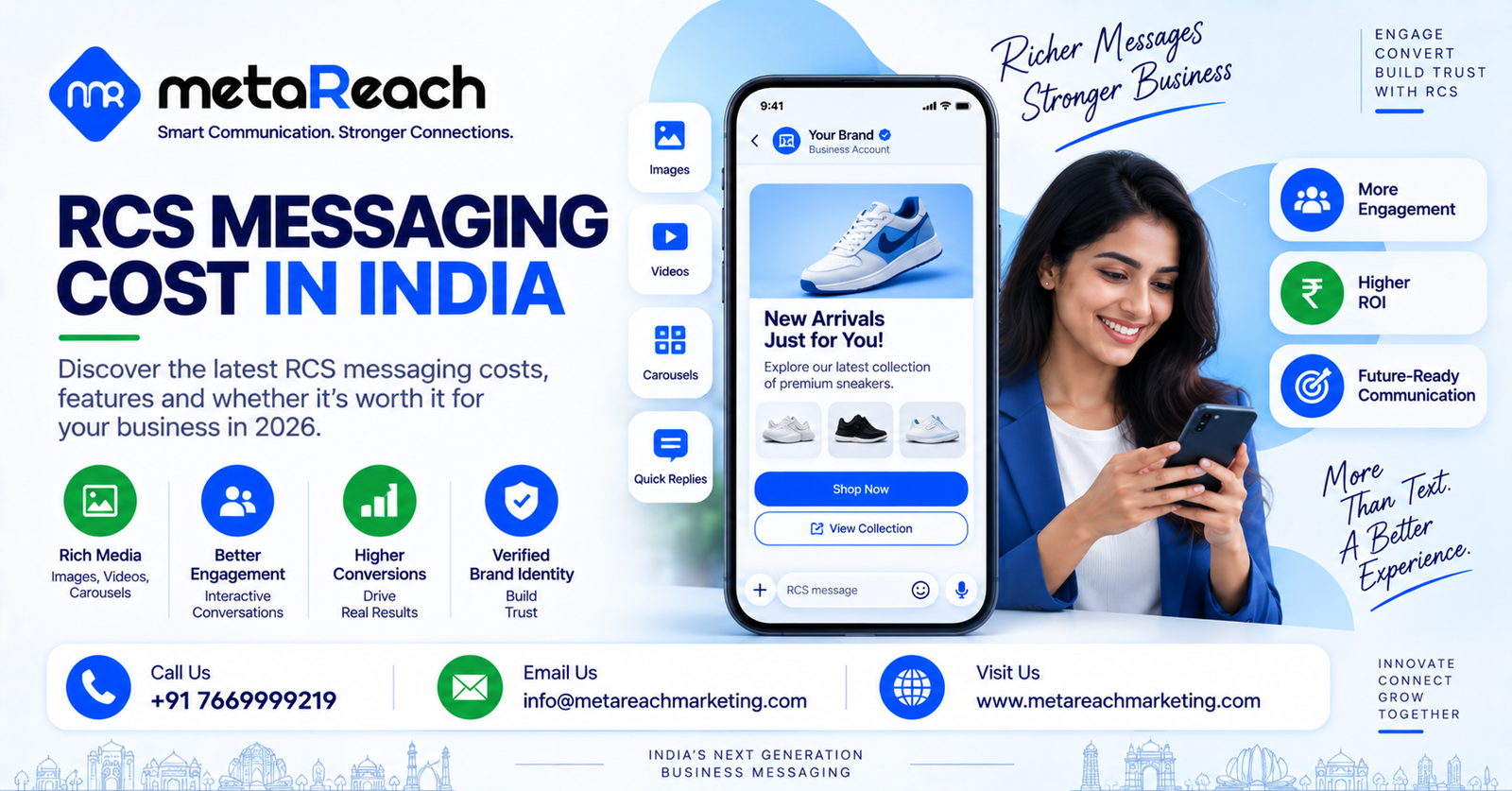
Every business that runs SMS campaigns in India eventually hears about RCS — Rich Communication Services — and the pitch usually sounds appealing: images, buttons, read receipts, a verified sender badge, all inside the native messaging app. What gets mentioned less often is that RCS also costs noticeably more per message than plain SMS, sometimes several times over depending on the provider and volume. That naturally raises the real question businesses need to answer before adding it to their stack: does the richer format actually earn back that extra cost, or is it paying for features a specific use case never uses?
Why RCS Costs More in the First Place
The price gap isn’t arbitrary. A plain SMS is a simple, fire-and-forget 160-character text with decades-old infrastructure behind it. RCS, by contrast, carries images, carousels, and interactive buttons, which take meaningfully more bandwidth and processing to deliver. Read receipts and typing indicators require the message to hold an active session rather than just firing off and disappearing. On top of that, RCS messages go through carrier and Google verification checks that plain SMS never has to clear, and today’s RCS-capable device base — while growing — is still smaller than SMS’s near-universal reach, so providers price it to reflect a more curated audience. None of this makes RCS overpriced; it genuinely costs more to deliver. The question a business actually needs to answer is whether its specific messages benefit enough from that richer format to justify the premium.
When the Extra Spend Tends to Pay Off
RCS earns its cost most clearly when a message genuinely needs more than plain text to do its job. A product carousel, an order-tracking update with a map link, or an appointment card with a reschedule button simply can’t exist in an SMS — RCS is the only channel among the two that supports them, and the engagement lift from visual, interactive content tends to be well documented across messaging channels generally. Read confirmation is another strong case: for something time-sensitive like an OTP, a delivery window, or an appointment reminder, knowing a message was actually seen — not just delivered — lets a business trigger a fallback SMS or call only when it’s genuinely needed, which can save cost elsewhere in the funnel. It also matters for messages where trust and brand perception carry weight; a verified sender badge and a properly formatted rich card can measurably improve how a payment confirmation or account alert is received, compared with a plain SMS that’s harder to distinguish from spam.
When Plain SMS Still Wins
The premium stops making sense in a few common situations. Anything where universal reach matters more than richness — a simple OTP or urgent alert that absolutely must land on every device regardless of type — is still better served by SMS, since it doesn’t depend on the recipient having an RCS-capable device or app. High-volume, low-value transactional pings, like routine delivery status updates sent by the million, are another case where the per-message cost gap compounds quickly and rarely earns its keep. And if a business genuinely doesn’t know how much of its audience has RCS-capable devices, paying RCS rates for messages that silently fall back to plain SMS anyway erodes the entire cost-benefit case before it’s even been tested.
A Practical Way to Decide, Instead of Guessing
Rather than switching an entire messaging volume over to RCS in one move, most businesses get a clearer answer by segmenting their message types. High-volume, low-value transactional pings can stay on SMS, while higher-value, engagement-sensitive messages — promotional carousels, payment confirmations, appointment reminders with rich cards — move to RCS. Running that RCS segment for four to six weeks and tracking click-through and response rate against the existing SMS baseline gives a business real data instead of a guess, and makes the decision to expand (or scale back) RCS usage far less risky.
A detailed cost-versus-value breakdown for RCS against SMS walks through exactly this kind of decision framework for Indian businesses, covering where the cost premium tends to be worth paying, where SMS still wins, and how to test the trade-off on a small segment before committing budget across an entire messaging programme.
Getting the Numbers Before Deciding
None of this cost-benefit thinking works without knowing the actual per-message numbers at your volume, since RCS pricing varies meaningfully by provider and commitment level. Businesses exploring this can look at what Meta Reach Marketing, a Noida-based enterprise communication and digital marketing agency, offers across RCS, bulk SMS, and WhatsApp Business API — three channels that, used together rather than as substitutes for one another, tend to give a business more flexibility than betting everything on a single messaging format.
The honest takeaway is that RCS isn’t a straight upgrade over SMS, and it was never meant to be. It’s a different tool with a different cost structure, worth paying for on the messages where richness and read confirmation genuinely change outcomes — and worth skipping on the messages where a plain, reliable text still does the job just as well for a fraction of the price.