A business with customers concentrated in Mumbai or Bangalore and a business with customers spread across smaller towns in Bihar or rural Madhya Pradesh are looking at genuinely different RCS realities, even though both technically operate in the same country under the same telecom operators. National coverage statistics tend to average these differences away, which can leave a business with a geographically spread customer base making decisions based on a picture that does not actually reflect its own audience. Understanding how RCS readiness genuinely differs across India’s metro, Tier 2, and rural markets helps set realistic expectations before launching a campaign that spans multiple regions.
to receive the full rich RCS experience rather than falling back to plain SMS, making RCS a genuinely strong channel choice for metro-focused campaigns with minimal caveats.
Tier 2 Cities: Strong But Slightly More Variable
Cities like Jaipur, Lucknow, Indore, Coimbatore, and similar Tier 2 hubs generally have solid RCS support today, since all three major operators have extended RCS Business Messaging well beyond the metro core. The main variable here tends to be device age rather than network availability, since Tier 2 markets often show a slightly higher share of older Android devices or budget smartphones that may lag on Google Messages updates compared to the newer device mix typical of metro markets. This does not mean RCS performs poorly in these cities; it simply means the delivery rate for the rich RCS experience specifically may run a touch lower than in a metro market, with a correspondingly larger share of contacts falling back to the still-fully-functional SMS version of the same message.
Rural and Smaller Towns: Where the Safety Net Actually Matters Most
In rural areas and smaller towns, RCS coverage genuinely lags behind metro and Tier 2 markets, driven by a combination of factors: patchier data connectivity in certain pockets, an older device mix, and, in some areas, a customer base still relying more heavily on feature phones than smartphones. This is precisely the scenario where automatic SMS fallback stops being a nice technical detail and becomes the entire reason RCS remains viable as a channel choice at all for a geographically diverse business. Without reliable fallback, a business sending RCS campaigns to a rural-heavy contact list would risk a meaningful share of contacts never receiving anything at all. With fallback properly configured, every contact still receives the message, just with a smaller share seeing the enhanced rich version rather than the plain-text one.
What This Means for a Business With a Mixed National Audience
A business selling nationally, whether an e-commerce brand, a financial services company, or an education platform with students across multiple states, should expect its overall RCS delivery rate to sit somewhere between the strong metro numbers and the more modest rural figures, weighted by how its actual customer base is distributed geographically. Rather than assuming a single national average applies uniformly, it is worth segmenting a campaign by rough geography where possible and setting realistic expectations for each segment separately. A campaign targeting metro customers can reasonably expect strong RCS engagement, while the same campaign sent to a more rural-heavy segment should be evaluated on its overall reach, including the SMS fallback portion, rather than judged purely on the rich-message delivery rate alone.
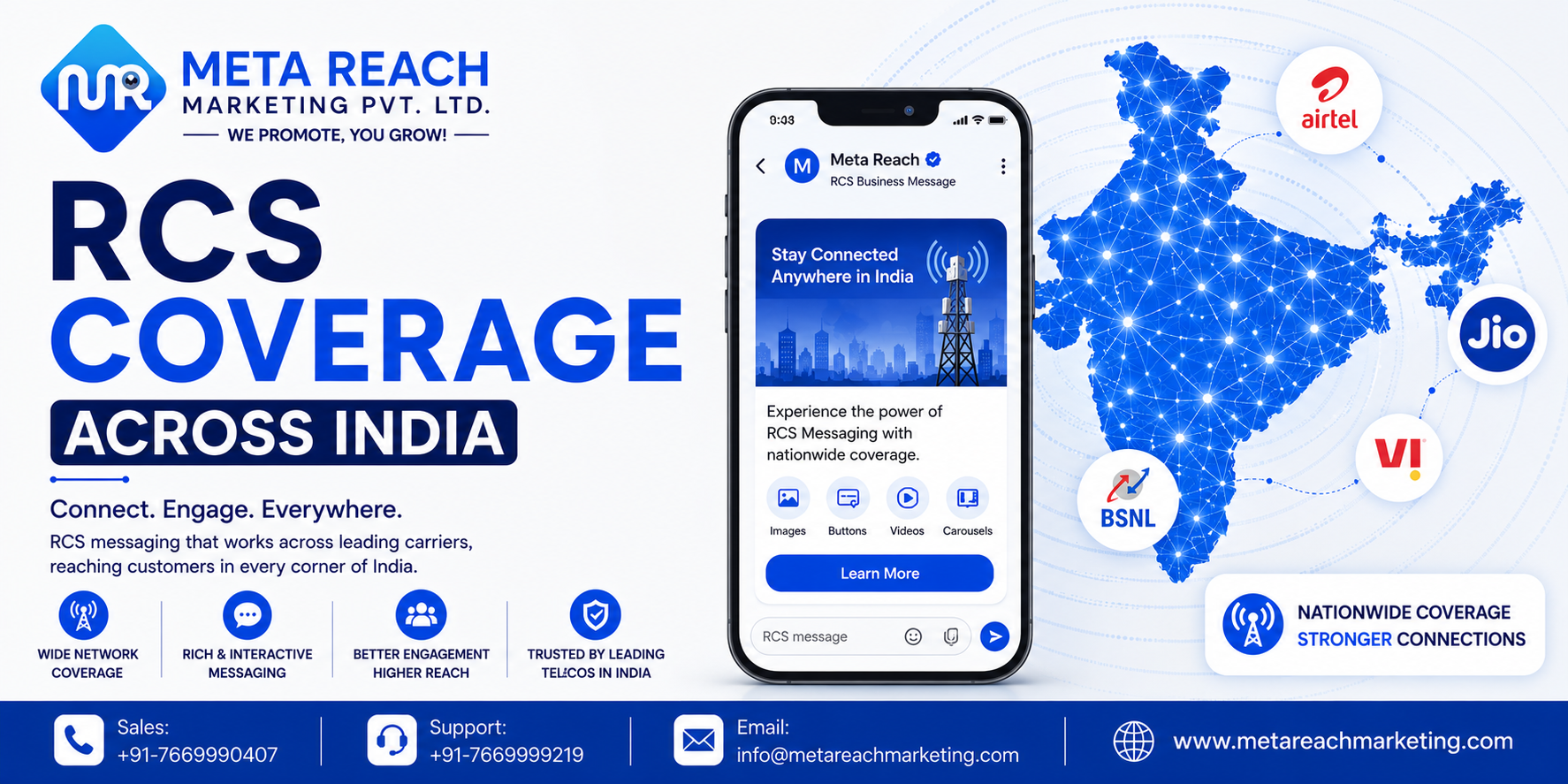
For a full breakdown of operator support and coverage patterns across India’s different market tiers, along with exactly how automatic SMS fallback protects total reach regardless of region, this RCS coverage guide for India lays out the current network and device landscape in detail.
Why This Gap Is Likely to Narrow Over Time
The gap between metro and rural RCS readiness is not a permanent state of affairs. As smartphone prices continue to fall and network infrastructure expansion continues across smaller towns and rural areas, device and connectivity gaps that currently limit RCS reach in these regions tend to close gradually over time, the same way earlier generations of mobile technology gradually reached full national coverage after initially concentrating in metro areas first. A business evaluating RCS today should treat the current rural gap as a present-day constraint worth planning around, not a permanent limitation that rules out the channel for a nationally distributed audience altogether.
A Practical Approach for Geographically Diverse Businesses
Rather than launching one uniform RCS campaign across an entire national contact list and hoping for the best, businesses with genuinely diverse geography tend to see better results by testing metro and non-metro segments separately first, comparing the real delivery data between them, and then deciding whether to run RCS uniformly, or reserve it specifically for the segments where it performs strongest while relying on plain SMS as the primary channel elsewhere. This segmented approach costs slightly more effort upfront but avoids both overestimating national RCS reach and underestimating how strong the channel already is specifically within metro-concentrated customer bases.
Businesses across India with customers spanning metro, Tier 2, and rural markets can explore what MetaReach Marketing offers as a direct-integration RCS platform with Jio, Airtel, and Vi, complete with geography-aware delivery reporting and automatic SMS fallback for guaranteed reach across every region.
In short, RCS coverage in India is not one uniform story but several distinct regional stories layered together, strongest in metro markets, still solid but slightly more variable in Tier 2 cities, and more dependent on SMS fallback in rural areas. A business with a geographically diverse customer base gets the most accurate picture by evaluating these segments separately rather than relying on a single national coverage statistic that averages away exactly the detail that matters most for planning a real campaign.