There’s a moment every app and website designer dreads: a user signs up, enters their number, and then just… waits. If the OTP takes ten seconds to arrive, most people assume something broke. Some retry. Many simply leave. It’s a small technical detail with an outsized business impact, and it’s exactly why OTP SMS infrastructure deserves more attention than most businesses give it.
What an OTP Actually Is
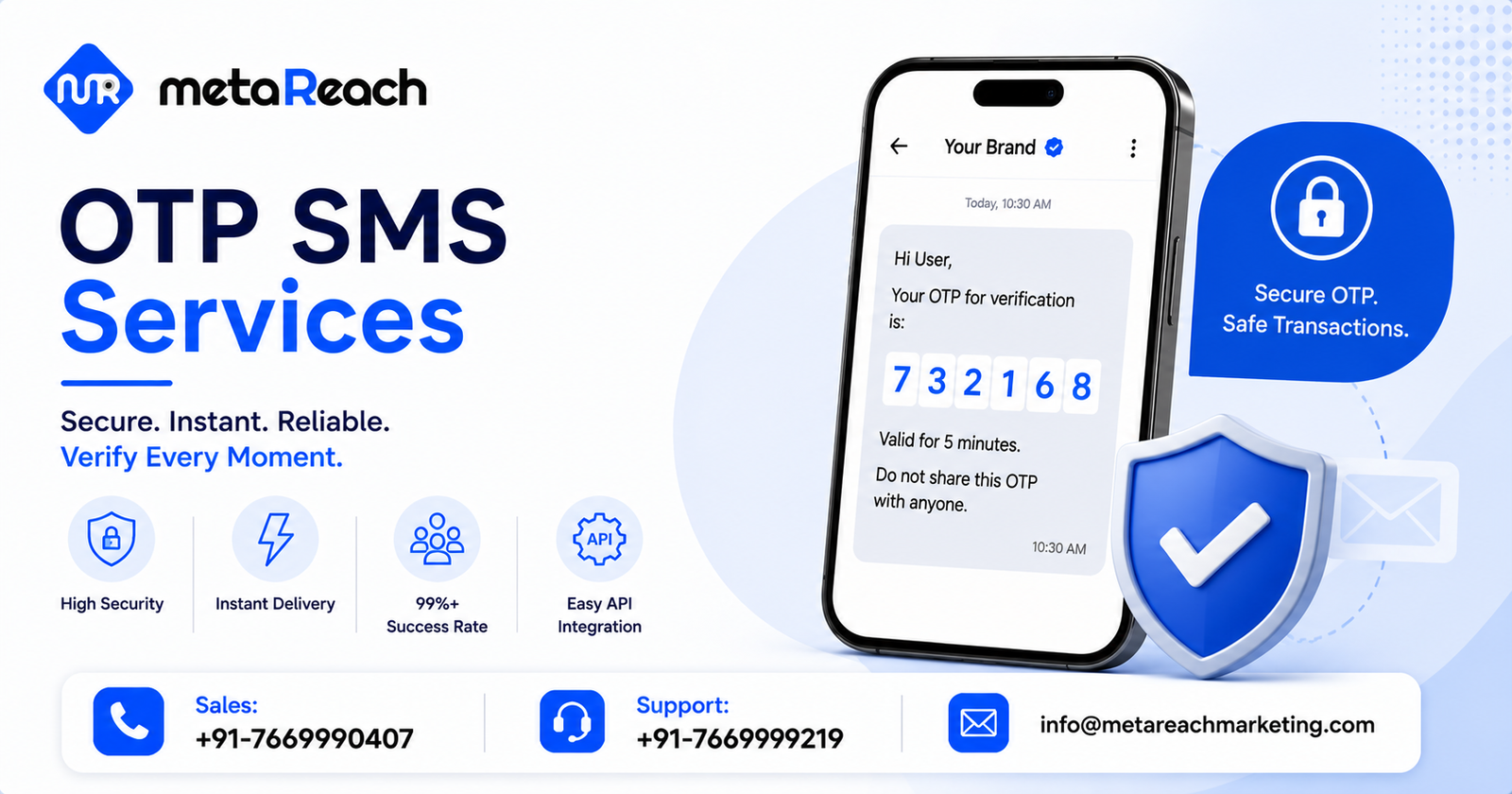
A One-Time Password is a short, auto-generated numeric code sent to a user’s phone to confirm they are who they claim to be. It’s used during login, signup, payment approval, and password resets, and it expires after a single use or a short time window — which is what makes it meaningfully more secure than a reused static password. Because OTPs are classified as transactional rather than promotional messages under Indian telecom rules, they’re allowed to reach every number, including those registered on the Do Not Disturb list, at any hour of the day.
Why Delivery Speed Is the Whole Game
For most SMS use cases, a delay of a few seconds barely registers. For an OTP, it’s the difference between a completed signup and an abandoned one. Users have been conditioned by UPI and banking apps to expect codes within a handful of seconds, and anything slower reads as a broken product rather than a slow network. This is why serious OTP providers route these messages on dedicated, priority connections separate from ordinary bulk or promotional traffic — mixing the two means an OTP can end up queued behind a marketing blast, which defeats the entire purpose of instant verification.
The DLT Requirement Nobody Can Skip
Every commercial SMS sender in India, OTP providers included, has to register under TRAI’s DLT (Distributed Ledger Technology) framework before sending a single message. This covers entity registration, sender ID assignment, and approval of the exact message templates being used — and it applies regardless of how small or early-stage the business is. Skipping this step doesn’t just risk a compliance issue; unregistered senders often find their messages silently blocked by operators, which is a far worse failure mode than a slow delivery. A useful reference for exactly how this process works is Meta Reach Marketing’s
OTP SMS service page, which breaks down how DLT-approved OTP routing works alongside dedicated delivery infrastructure for Indian mobile networks.
Where OTP SMS Fits Alongside Other Verification Channels
SMS remains the default choice for OTP delivery because it works on every phone, including basic feature phones with no internet connection — something app-based authenticators and even WhatsApp OTPs can’t claim. That said, a well-designed verification system doesn’t rely on a single channel. Many businesses now configure automatic fallbacks: if an SMS doesn’t land within a set window, perhaps due to a network dip or a phone being switched off, the system triggers a voice call that reads the code aloud instead. This kind of layered approach matters most for platforms serving Tier-2 and Tier-3 cities, where connectivity can be less consistent than in metro areas.
Industries Where This Really Matters
Some sectors simply cannot tolerate authentication delays. Banking and fintech platforms need sub-second reliability for payment approvals and fraud prevention, since a slow OTP during a transaction can look identical to a failed one from the user’s side. E-commerce platforms lose checkout conversions every time a verification step drags on, particularly during high-traffic sale periods. Healthcare platforms use OTPs to protect sensitive patient portals, where both security and speed matter for patient trust. Even coaching institutes and EdTech platforms rely on OTPs for enrollment and exam registration, where a failed verification can mean a missed deadline for a student.
What to Actually Check Before Choosing a Provider
When comparing OTP SMS providers, a few practical questions tend to matter more than the headline per-SMS price. Does the provider route OTPs separately from bulk promotional traffic, or do they share the same queue? Is DLT registration included, or billed as a separate service? What’s the realistic average delivery time — not the best-case number, but what happens during peak load? And is there a fallback channel, like voice OTP, for the cases where SMS genuinely can’t get through? A provider that answers these clearly, rather than deflecting to a generic feature list, is usually the safer long-term choice.
The Cost of Getting This Wrong
It’s easy to underestimate how much a shaky OTP flow actually costs a business. Every failed or delayed verification is a user who either retries in frustration or abandons the signup or checkout entirely — and unlike a marketing email that can be resent later, a failed real-time authentication moment rarely gets a second chance. For high-volume platforms, even a small percentage improvement in OTP delivery speed and reliability can translate into a meaningful lift in completed signups and transactions, which is why this is worth treating as a core infrastructure decision rather than an afterthought bolted onto a messaging vendor contract.
The Bottom Line
OTP SMS looks like a minor technical detail from the outside, but it sits directly in the path of every login, signup, and payment a business processes. Getting it right means dedicated transactional routing, full DLT compliance, and a fallback plan for when SMS alone isn’t enough. Businesses evaluating providers on this basis, rather than price alone, tend to see it reflected in fewer support tickets and higher conversion at exactly the moments that matter most.
Meta Reach Marketing, a Noida-based enterprise communication and digital marketing agency, documents its approach to this in detail on its OTP SMS service page — a reasonable starting point for any team benchmarking their current OTP setup.