Ask five different bulk SMS providers in India for a quote, and you’ll likely get five different numbers, five different explanations for why their rate is fair, and at least two mentions of a setup fee you didn’t ask about. Bulk SMS pricing in India looks simple on the surface — it’s a per-message rate — but comparing providers properly means looking well past that one number.
Why the Per-SMS Rate Alone Doesn’t Tell You Much
A quoted rate of, say, ₹0.14 per SMS means very little without context. Does that rate apply to promotional SMS, transactional SMS, and OTP SMS equally, or does it jump once you need DND-exempt, priority delivery? Is DLT registration — mandatory for every business sending bulk SMS in India — included in that price, or billed separately as a service fee on top of the government’s own registration charge? Is there a minimum monthly volume you have to commit to regardless of whether you actually send that many messages? These details are exactly where the real cost difference between providers tends to show up, often more than the headline rate itself.
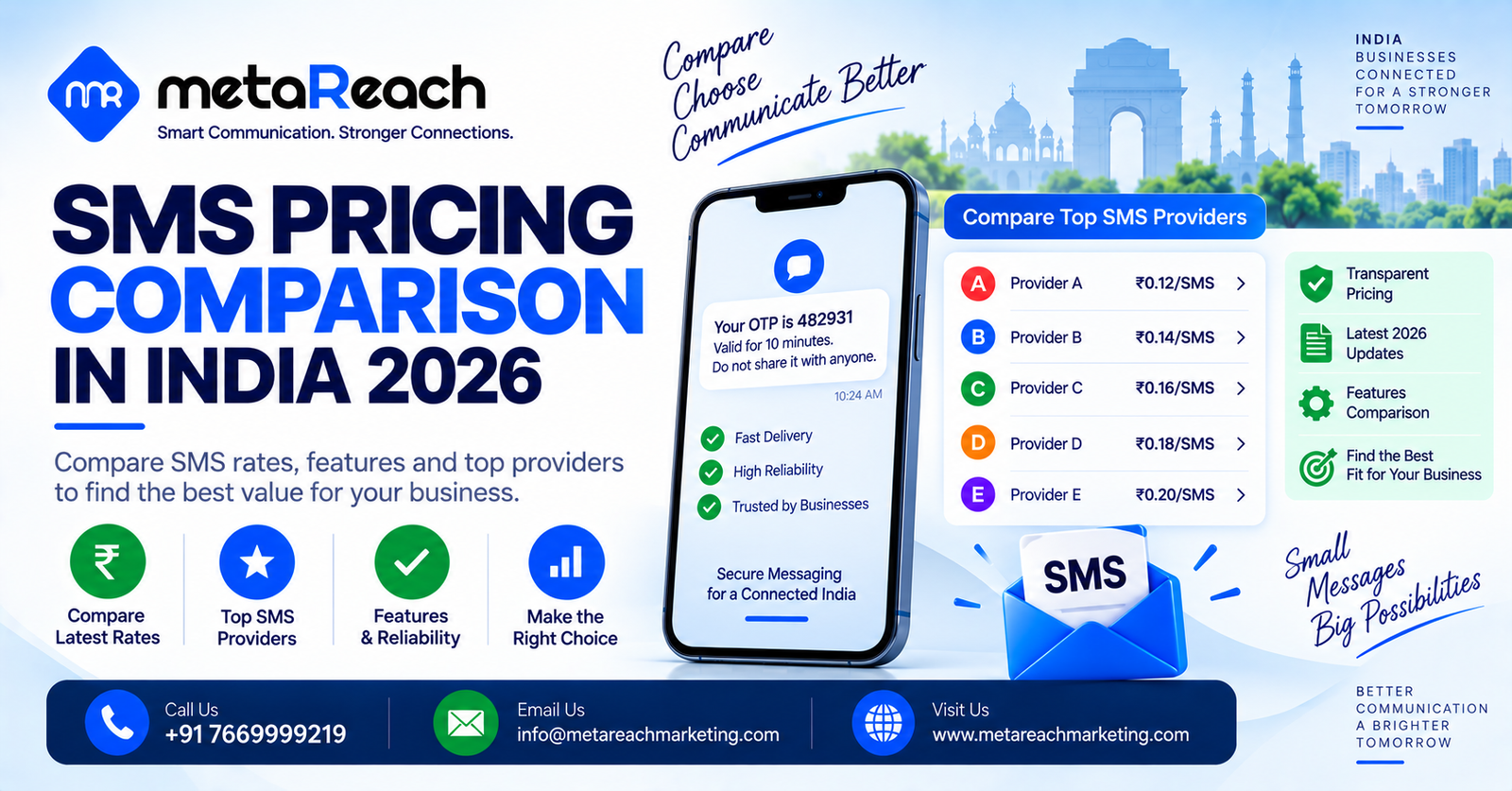
A current breakdown of bulk SMS pricing across India’s major providers is a useful way to see these variables laid out side by side — per-SMS rates for promotional, transactional, and OTP messages, along with DLT handling, setup costs, and minimum volume requirements for each provider. Looking at that kind of side-by-side view before signing a contract makes it much easier to spot which parts of a quote are genuinely competitive and which are inflated by fees that don’t need to exist.
Promotional vs Transactional vs OTP — Why the Type of SMS Changes the Price
Not all SMS is priced the same, and there’s a real regulatory reason for that. Promotional SMS is blocked on DND-registered numbers and can only be sent within a fixed daily window, which keeps its rate on the lower end. Transactional and OTP SMS, on the other hand, are exempt from DND restrictions and need to be deliverable at any hour — including the middle of the night for a payment confirmation or login attempt — which usually means priority routing and a slightly different pricing structure. Any comparison that quotes a single flat number for “SMS in India” without separating these categories is oversimplifying what businesses actually pay for.
The DLT Registration Line Item Businesses Often Miss
TRAI’s DLT (Distributed Ledger Technology) framework requires every business sending bulk SMS to complete entity registration, sender ID approval, and template registration before a single message can legally go out. There’s a fixed government charge attached to this that no provider can waive, but what varies significantly is the service fee a provider charges to actually walk a business through that process. Some bundle it into onboarding at no extra cost; others treat it as a paid add-on that only becomes visible once a business is already partway through signing up. It’s worth asking this question directly and early, since it can shift the real cost of a plan by a meaningful margin, especially for a smaller business sending a modest monthly volume.
What Volume Does to the Comparison
Pricing that looks attractive at one volume tier can look very different at another. Some providers offer a flat rate regardless of how many messages a business sends per month, while others require a high minimum commitment before they’ll even discuss pricing, which effectively locks smaller businesses out. A useful exercise before choosing a provider is to work out what the actual monthly bill would look like at your real, current volume — not a hypothetical future volume — since minimum commitments and setup fees can quietly erase the savings promised by a lower per-SMS rate.
Support Quality Is Part of the Price, Even If It Isn’t on the Invoice
The cheapest SMS rate stops looking cheap the moment a campaign fails to deliver and support is unreachable for two days. It’s worth factoring in whether a provider offers real-time phone or WhatsApp support versus a ticket-based system with a multi-day response window, since delivery issues in transactional and OTP SMS tend to be time-sensitive by nature. A provider that’s genuinely responsive when something goes wrong is often worth a marginally higher rate than one that’s cheaper on paper but slow to respond when a client actually needs help.
Putting the Comparison Together
Before signing up with any bulk SMS provider in India, it’s worth getting clear, written answers on five things: the exact per-SMS rate for each message type you’ll actually use, whether DLT registration is included or billed separately, whether there’s a minimum volume commitment, what the setup fee looks like (if any), and what support actually looks like once you’re a paying customer rather than a prospect. Providers that answer all five clearly and up front, rather than pushing you toward a sales call for custom pricing, tend to be the more transparent option long-term.
Businesses looking to see these variables laid out for a specific set of India-based providers can review Meta Reach Marketing’s independent bulk SMS pricing comparison, which breaks down per-message rates, DLT handling, minimum volumes, and support models across several well-known platforms in one place. It’s a reasonable starting point for benchmarking whatever quote you currently have — or the one you’re about to accept.