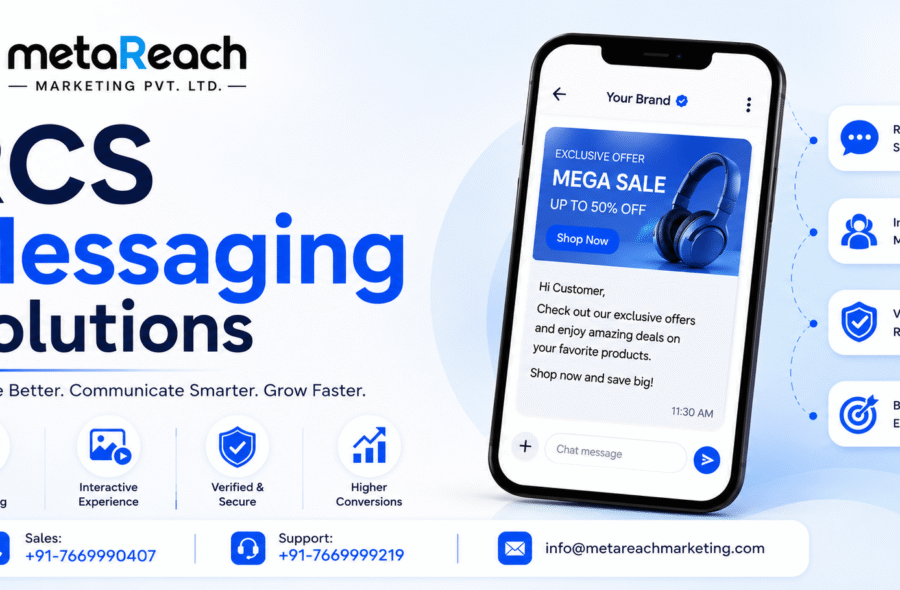
RCS costs more per message than plain SMS, and a business considering the switch deserves a genuine, data-backed answer to whether that extra cost is justified, rather than a general assurance that rich media ‘performs better.’ The honest way to answer this question is to measure it directly against a business’s own campaigns and its own audience, since industry-wide averages rarely predict exactly how a specific offer, sent to a specific list, will actually perform on one channel versus another.
Running a Genuine Side-by-Side Test Before Committing a Full Budget
The clearest way to judge RCS’s real value is a direct A/B test: splitting a contact list into two comparable segments, sending the identical offer as a rich RCS card to one and as plain SMS to the other, and comparing actual results rather than assumptions. This kind of test removes guesswork entirely, since both segments receive the same underlying offer and only the format differs. Running this test on a modest sample before committing to RCS for an entire campaign or contact list gives a business real numbers specific to its own audience, rather than relying on general industry claims about RCS engagement that may or may not apply to a particular customer base.
The Metric That Actually Answers the Cost Question: Cost Per Conversion, Not Cost Per Message
Comparing RCS and SMS purely on cost per message will always favour SMS, since RCS genuinely costs more to send. The comparison that actually matters is cost per completed conversion, dividing total campaign spend by the number of actual purchases, bookings, or whatever specific action the campaign was built to drive. If RCS’s higher engagement translates into a meaningfully higher conversion rate, the cost per conversion can end up lower on RCS despite the higher per-message price, since fewer total messages are needed to produce the same number of actual results. This is the number worth calculating explicitly after any test campaign, rather than stopping the analysis at the more obvious but less meaningful per-message cost comparison.
Why Some Message Types Will Never Justify the Extra Cost
It is worth being honest that not every message type will show a meaningful RCS advantage, even after a fair test. A simple, purely informational alert with no visual component and no action a customer needs to take, a basic order status update with nothing else attached, is unlikely to show a dramatically different conversion outcome between SMS and RCS, since there is little for the rich media to meaningfully improve in the first place. Testing reveals this distinction clearly: message types where RCS shows a genuine conversion lift are worth the extra cost, while message types showing no measurable difference are better left on plain SMS, where the lower cost has no offsetting downside.
Accounting for Setup and Ongoing Management Time, Not Just Per-Message Cost
A full, honest cost comparison should also factor in the time investment RCS genuinely requires beyond the per-message rate: designing rich cards, managing image assets, and testing different creative variants all take real time that a plain SMS campaign does not demand to nearly the same degree. For a small business without dedicated marketing resources, this additional time cost is a genuine factor worth weighing alongside the per-message price difference, since the true cost of a channel includes the labour required to use it well, not just the invoice from the messaging provider.
For a full breakdown of RCS pricing, testing support, and how automatic SMS fallback protects total reach during any comparison campaign, this RCS messaging service page covers the complete platform, pricing structure, and campaign testing process in detail.
Building a Simple Ongoing Comparison Habit Rather Than a One-Time Test
A single test campaign gives useful initial signal, but a business’s real audience behaviour, device mix, and response patterns can shift over time, particularly as RCS adoption and device compatibility continue to expand across India. Running an occasional refresh test every few months, rather than treating one early comparison as permanently conclusive, keeps a business’s channel allocation aligned with current reality rather than an assumption that may no longer hold true a year or two later, especially as RCS coverage and customer familiarity with the format continue to grow.
What a Reasonable Rollout Looks Like Once Testing Confirms Real Value
Once testing confirms RCS produces a genuinely better cost per conversion for a specific message type, the sensible next step is scaling that specific campaign type to the full contact list, while continuing to test other message types individually before expanding RCS use to them as well. This measured, message-type-by-message-type rollout, rather than switching an entire messaging program to RCS all at once based on one successful test, protects a business from over-committing budget to a format that may not perform as well across every kind of message it currently sends.
Businesses across India wanting to test RCS against SMS with real cost-per-conversion data specific to their own audience can explore what MetaReach Marketing offers with A/B testing support and detailed conversion tracking across both channels.
In short, whether RCS is worth its higher cost is not a question with a universal answer, but one a business can answer definitively through a genuine side-by-side test measured on cost per conversion rather than cost per message. Some message types will clearly justify the investment; others will not, and testing reveals exactly which is which, allowing a business to allocate its messaging budget based on real, specific data rather than a general assumption about what richer media should theoretically achieve.