A business sending its first bulk SMS campaign in India usually has the same handful of questions running through their head: is this actually legal, how much will it cost, how fast will it arrive, and how hard is it to set up. None of these questions are complicated once answered directly, but the sheer number of providers, pricing structures, and compliance requirements can make bulk SMS feel more intimidating than it actually is for a first-time sender. Here is a straightforward walkthrough of what actually matters before sending that first message.
Yes, It’s Legal — But Only Through the Right Channel
Bulk SMS is completely legal in India, provided it goes through a properly DLT-registered platform that follows TRAI’s guidelines. This means a registered sender ID, pre-approved message templates, and automatic DND filtering for anything promotional in nature. A business trying to send bulk messages through an unregistered route, or through a personal number scaled up artificially, is not just risking poor delivery; it is operating outside the legal framework entirely, and messages sent this way typically fail to deliver on any major network regardless of how well the content is written. Choosing a genuinely DLT-compliant provider from the outset removes this concern completely, since a proper platform handles registration as a standard part of onboarding rather than something a business has to navigate on its own.
Understanding the Three Core Message Types Before You Start
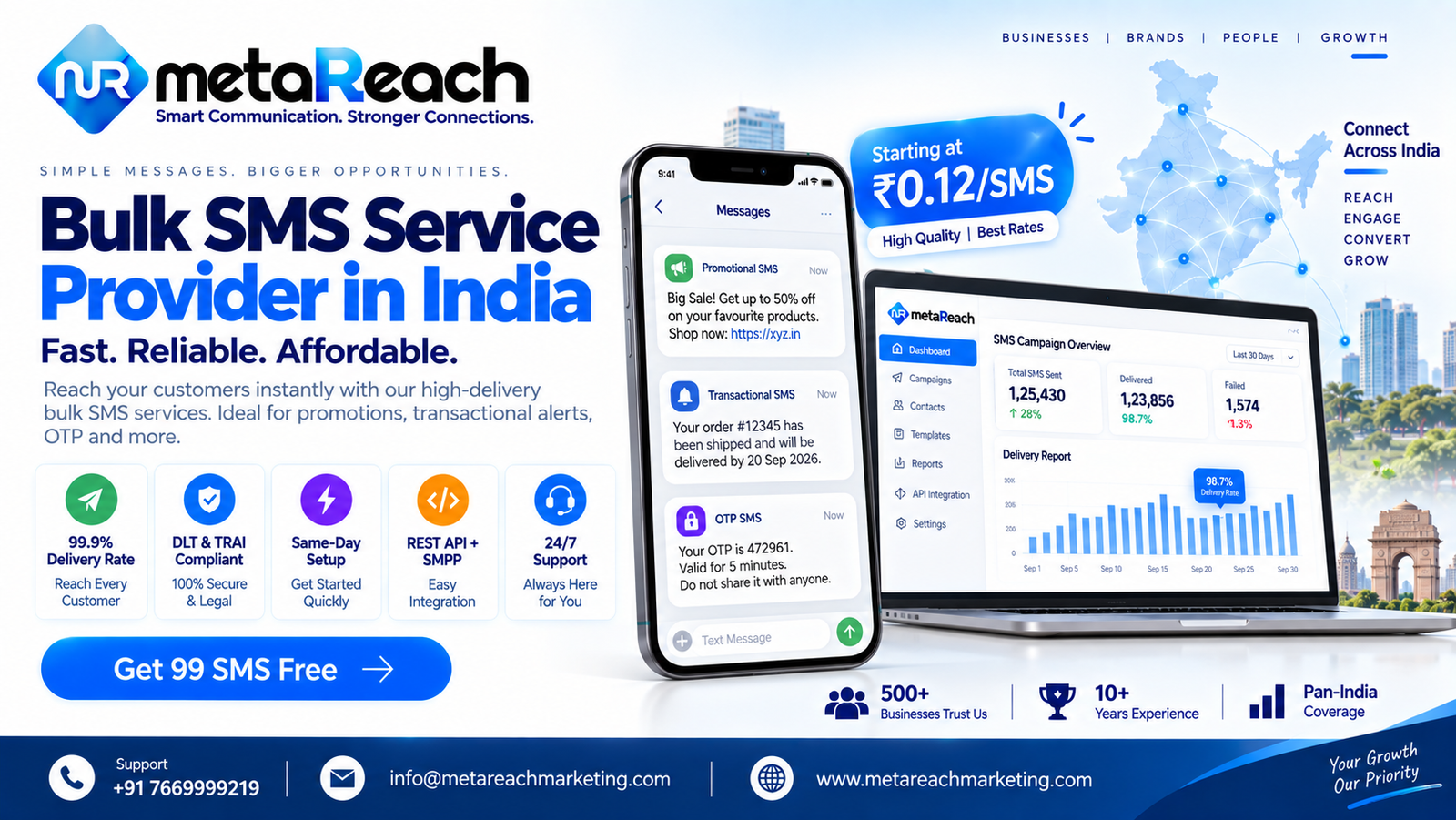
New senders often assume all bulk SMS is the same, but India’s regulatory framework treats three categories quite differently. Promotional SMS covers offers, discounts, and campaigns, and can only reach non-DND numbers within a specific daytime window. Transactional SMS covers order confirmations, appointment reminders, and account notifications, and can reach every number around the clock since it bypasses DND restrictions as an essential rather than promotional communication. OTP SMS is a specific subset of transactional messaging built for login and payment verification, routed through dedicated, high-priority infrastructure to guarantee delivery within a handful of seconds. Understanding which category a specific message actually falls into, before writing or sending it, prevents both compliance issues and unnecessary delivery failures down the line.
Why Delivery Speed Genuinely Varies Between Providers
Not every provider delivers at the same speed, even though most advertise fast delivery uniformly. The real differentiator is whether a provider has direct connections into major telecom operator networks or routes traffic through several layers of intermediary aggregators before it reaches a phone. Direct routing genuinely delivers faster and more reliably, particularly under peak load when a large campaign or a burst of simultaneous OTP requests puts real pressure on the infrastructure. A new business evaluating providers should ask specifically about real-world delivery benchmarks under peak conditions, not just delivery speed on a quiet test send, since the two can differ meaningfully.
What to Actually Test Before Committing to a Provider
Rather than committing to a provider based on a sales pitch alone, it is worth testing a small batch of real messages against an actual contact list before scaling up. This test reveals genuine delivery rates, response time, and message rendering across different phone types, giving a business real data rather than a marketing claim to base a decision on. Many providers offer a modest free allowance specifically for this purpose, letting a new business confirm delivery quality with real numbers before committing any budget, which is a genuinely useful way to de-risk the decision before a larger campaign goes out.
For a complete overview of message types, pricing tiers, and a free starter allowance to test delivery before committing, this bulk SMS service page for India lays out the full platform, DLT support process, and industry-specific use cases in detail.
The Setup Process Is Usually Faster Than People Expect
A common misconception among first-time senders is that getting a bulk SMS program running takes weeks. In practice, a business with a properly registered entity can typically complete DLT registration, upload an initial contact list, and send a first test campaign within the same day, provided the chosen provider handles the registration paperwork as part of onboarding rather than leaving a business to navigate TRAI’s DLT portal independently for the first time. The steps genuinely are straightforward: register an account, complete entity and sender header registration, upload contacts via a spreadsheet or API, and send. Businesses that get stuck for days or weeks are usually dealing with a provider that has not streamlined this process, rather than the process itself being inherently slow.
Thinking Beyond the First Campaign
A first bulk SMS campaign is rarely where a business’s messaging needs end. Once the fundamentals are in place, it is worth thinking ahead to whether a CRM or website integration via API would streamline future sending, whether OTP delivery will eventually be needed for a login or checkout flow, and whether other channels like WhatsApp or voice calling might eventually complement SMS as a business’s communication needs grow. Choosing a provider that supports this kind of expansion from day one, even if a business only needs basic SMS initially, avoids a disruptive migration to a different platform later once genuine growth demands more than a single channel can offer.
Businesses across India sending their first bulk SMS campaign can explore what MetaReach Marketing offers with free DLT registration support, transparent per-message pricing, and a modest free starter allowance to confirm delivery quality before committing to a larger campaign.
In short, sending a first bulk SMS campaign in India is considerably simpler than it looks from the outside, provided the fundamentals are understood upfront: choose a genuinely DLT-compliant provider, understand which message category a specific communication falls into, test real delivery before scaling, and think ahead to how messaging needs might grow beyond a single first campaign. Getting these basics right from day one saves considerably more time than learning them the hard way after a campaign has already gone out.