Every smartphone in Noida seems to have one thing in common: WhatsApp. It’s rarely uninstalled, almost always open, and checked far more often than email or even a business’s own app. That single fact has quietly turned it into one of the most effective marketing channels available to Indian businesses — not because it’s new, but because it goes where customers already are, instead of asking them to go somewhere else.
Why Open Rates Tell the Real Story
The comparison against older channels isn’t close. A typical bulk SMS campaign gets opened by 25 to 30% of recipients; a promotional email is lucky to clear 20%. WhatsApp campaigns routinely see open rates above 95%. Part of that comes down to trust — people check WhatsApp the way they check texts from friends, not the way they scroll past marketing email. Part of it comes down to reach: WhatsApp runs over the internet rather than the telecom network, so it isn’t blocked by DND restrictions the way promotional SMS is.
That combination of reach and trust is exactly why more businesses across Sector 18, Sector 62, and Greater Noida West are shifting budget toward WhatsApp marketing services in Noida instead of relying purely on SMS or email to reach their customer base.
What Separates a Real Campaign From a Risky One
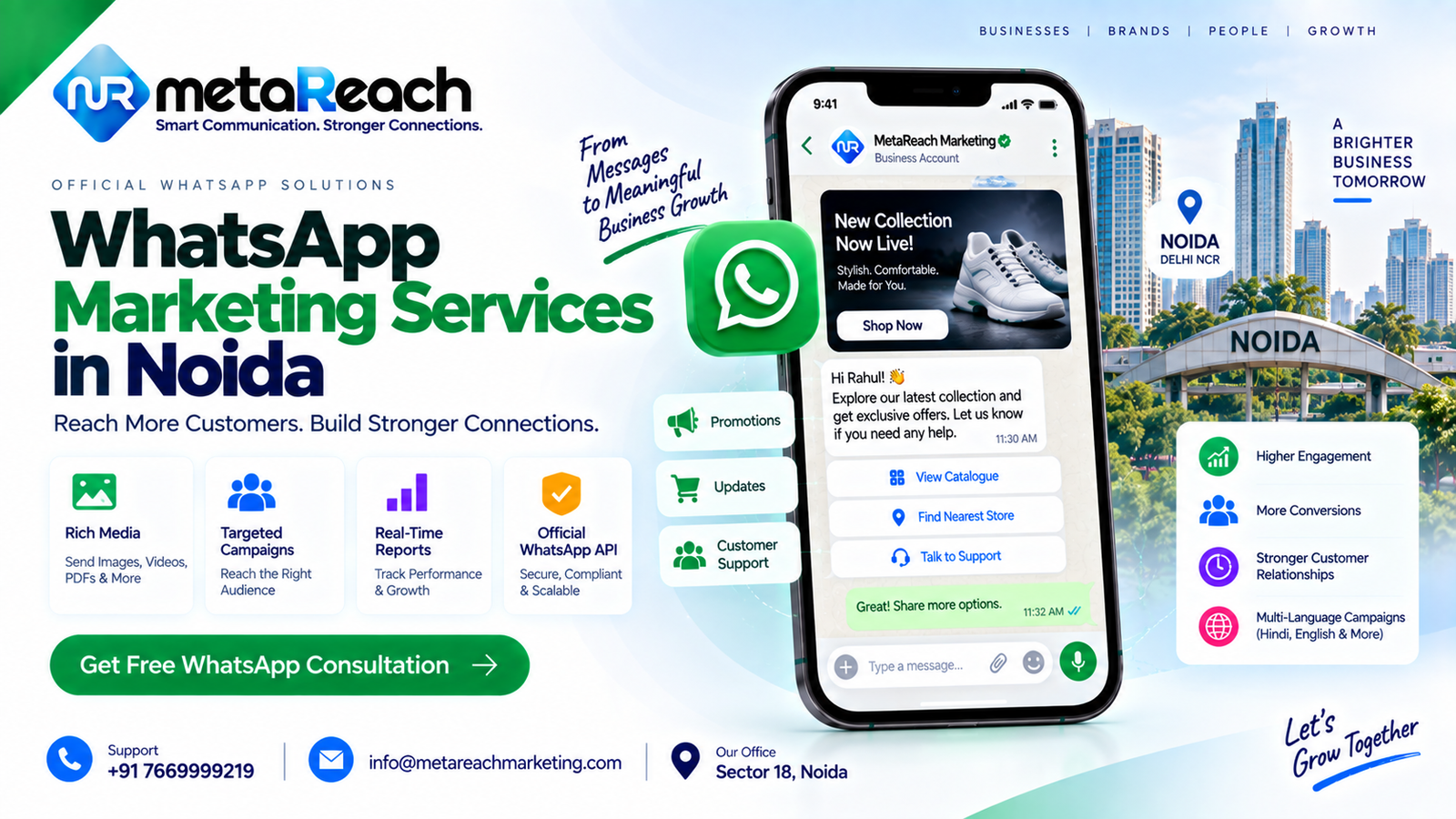
There’s an important distinction that gets missed often: sending bulk messages from a personal WhatsApp number isn’t just risky, it usually gets the number banned outright. A proper campaign runs on the official WhatsApp Business API, accessed through an approved provider, with pre-approved message templates and a genuinely opted-in contact list. That’s the difference between a compliant, scalable channel and a shortcut that collapses the first time volume increases.
- Consent-based list management — messaging only customers who’ve actually opted in, not a purchased or scraped list.
- Rich media formats — images, videos, PDFs, product catalogues, and clickable buttons that plain SMS simply can’t carry.
- Two-way conversation — customers can reply, ask questions, and get a response, instead of receiving a one-way broadcast.
- Delivery and read receipts — knowing not just who received a message, but who actually opened it.
How Different Industries Are Actually Using It
The use cases shift depending on who’s sending the message. Real estate developers use WhatsApp to send property photos, pricing sheets, and site-visit links directly to interested buyers — converting an enquiry into a booking faster than a phone call could. Healthcare clinics send appointment reminders and lab results through a verified business account rather than an unmarked SMS number, which patients tend to trust more. Education institutes push admission updates and fee reminders to both students and parents in one broadcast. E-commerce brands lean on it for order confirmations, delivery tracking, and recovering abandoned carts — all with far higher engagement than an equivalent email would get.
What connects all of these use cases is that WhatsApp isn’t being used as a replacement for other channels — it’s being used where it genuinely performs better, alongside SMS and email rather than instead of them.
Getting the Setup Right the First Time
Getting access to the official API involves Meta Business verification, template creation and approval, and integration into a business’s existing systems — none of which is difficult, but all of which is easy to get wrong on a first attempt. Rejected templates, unverified business accounts, and non-compliant messaging are the most common reasons a first campaign stalls before it even launches.
This is where working with an experienced, Noida-based team like MetaReach Marketing tends to save real time. With over a decade of experience running SMS, WhatsApp, and voice campaigns for 500+ businesses across Delhi NCR, the setup process — verification, template approval, CRM integration — is usually handled in 48 to 72 hours rather than the weeks it can take going in cold.
The Bottom Line
WhatsApp marketing isn’t a trend that will fade the way some digital tactics do — it’s simply where Indian customers already spend their attention, and businesses that meet them there tend to see it in their engagement numbers within the first campaign. For businesses in Noida still relying only on SMS or email, the gap in open rates alone is usually enough reason to at least test the channel properly, with the right compliance and infrastructure behind it.