Open your Android messaging app today and there’s a good chance a business message you received recently didn’t look like the plain grey SMS bubbles of a decade ago. It had a logo, maybe a product image, a couple of buttons, and a small verified badge next to the sender’s name. That’s RCS — Rich Communication Services — and it’s quietly becoming the default way Indian businesses talk to customers on their phones, without needing them to install a separate app.
What Makes RCS Different From Plain SMS
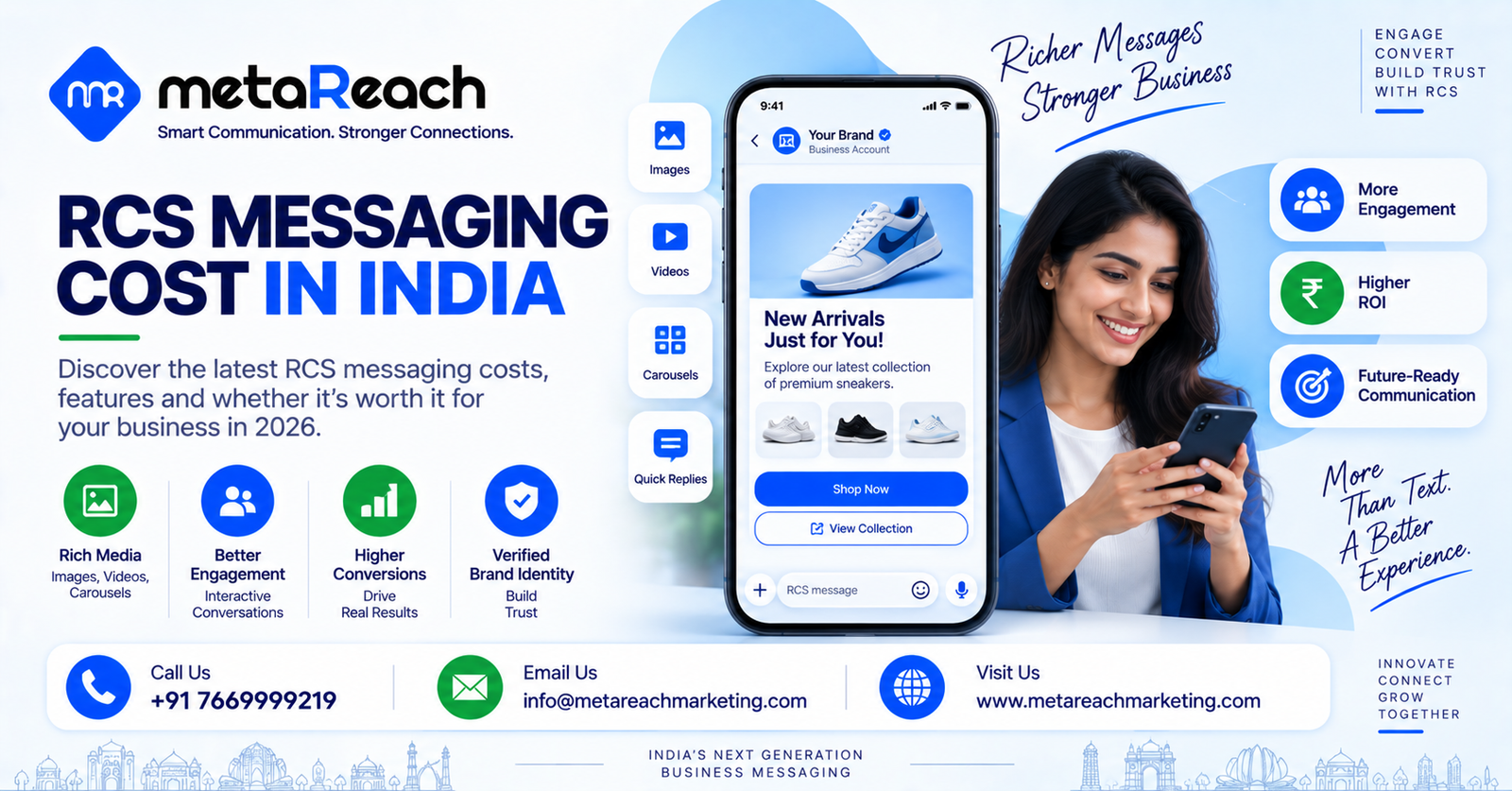
Traditional SMS has been stuck at 160 characters of plain text for decades, with no way to verify who’s actually sending it — which is exactly why SMS-based phishing has become such a problem. RCS removes that ceiling entirely. Businesses can send images, short videos, product carousels, and interactive buttons, all inside the same native messaging app the customer already uses, with no download required. Every RCS message also carries a verified business name and logo, so the person receiving it knows immediately it’s genuinely from the brand and not a spoofed sender pretending to be their bank or delivery service.
That combination — richer content plus verified identity — is why RCS tends to outperform plain SMS on open and click-through rates. It behaves less like an old-fashioned text message and more like a lightweight, native version of a chat app conversation.
How Far RCS Actually Reaches in India
RCS in India runs on Android devices through Google Messages, and it’s now supported across the country’s three major telecom operators — Jio, Airtel, and Vodafone Idea — covering a very large share of the country’s active mobile subscriber base. Coverage isn’t limited to metro cities either; Tier-2 and Tier-3 towns with reasonable 4G connectivity increasingly fall within RCS reach as adoption continues to grow. iPhone support is a more recent development and is still rolling out in India, so the channel today is primarily an Android story.
The one design detail that matters most for businesses is fallback: a properly configured RCS campaign automatically drops back to standard SMS the moment it detects a recipient’s device or network doesn’t support RCS. That means a business doesn’t have to choose between reach and richness — it gets the richer experience wherever it’s supported, and a guaranteed plain-text delivery everywhere else.
Where RCS Genuinely Changes the Outcome
Certain kinds of business messages benefit far more from RCS than others. A product promotion with an image and a “Shop Now” button naturally invites a tap in a way a plain-text discount code never will. An appointment reminder that includes a map link and a reschedule button removes an entire back-and-forth phone call. An OTP or transaction alert carrying a verified brand name and logo is far less likely to be mistaken for a phishing attempt, which matters enormously for banks, fintech platforms, and healthcare providers operating in an environment where SMS fraud has become common. Order tracking, delivery updates, and loyalty programme messages also tend to feel more complete as rich cards than as a string of plain-text updates.
A closer look at how RCS messaging works for businesses in India covers these use cases across industries in more depth — from e-commerce and banking to healthcare, education, real estate, and travel — along with the specific network coverage and verification process businesses need to go through before launching a campaign.
RCS, SMS, and WhatsApp Aren’t Really Competing — They’re Complementary
It’s tempting to think of RCS as a straight replacement for SMS or a cheaper alternative to WhatsApp Business API, but in practice most businesses get better results treating all three as parts of the same toolkit. SMS remains unmatched for pure reach — it works on every device, including old Android phones and basic handsets, with no dependency on internet connectivity at the moment of delivery. WhatsApp Business API is strongest for ongoing, conversational, two-way support once a customer has opted in. RCS sits in between: richer and more trustworthy than SMS, native to the phone’s default messaging app rather than requiring a separate download the way WhatsApp does, which gives it an edge in markets where WhatsApp adoption is still catching up.
Getting a Campaign Off the Ground
Setting up RCS isn’t something a business does alone by flipping a switch — it involves brand verification with the telecom operators and Google’s messaging infrastructure, creative development for rich cards and carousels, and campaign deployment with fallback logic built in. Businesses considering the switch are usually better served by starting with a single, well-defined use case — appointment reminders or order confirmations tend to be a low-risk starting point — and measuring the engagement lift before expanding to a full messaging programme.
For businesses exploring this, Meta Reach Marketing, a Noida-based enterprise communication and digital marketing agency, handles the entire RCS setup process — strategy, sender verification, creative, deployment, and analytics — alongside bulk SMS, WhatsApp Business API, and IVR services, so a business isn’t left stitching multiple vendors together to run a coherent messaging strategy.
The bigger shift underway is less about any single feature and more about trust. As SMS-based fraud has grown more sophisticated, a verified sender badge and a properly branded message are becoming less of a nice-to-have and more of a baseline expectation from customers. RCS is one of the more practical ways Indian businesses are meeting that expectation without asking customers to install anything new.