Every time someone logs into a banking app, completes a checkout, or resets a forgotten password, there’s a good chance a small six-digit code lands on their phone within seconds. That code — the OTP, or one-time password — has quietly become the backbone of digital trust in India. It’s easy to overlook until it stops working, and that’s exactly when businesses realize how much rides on getting OTP delivery right.
What an OTP SMS Actually Does
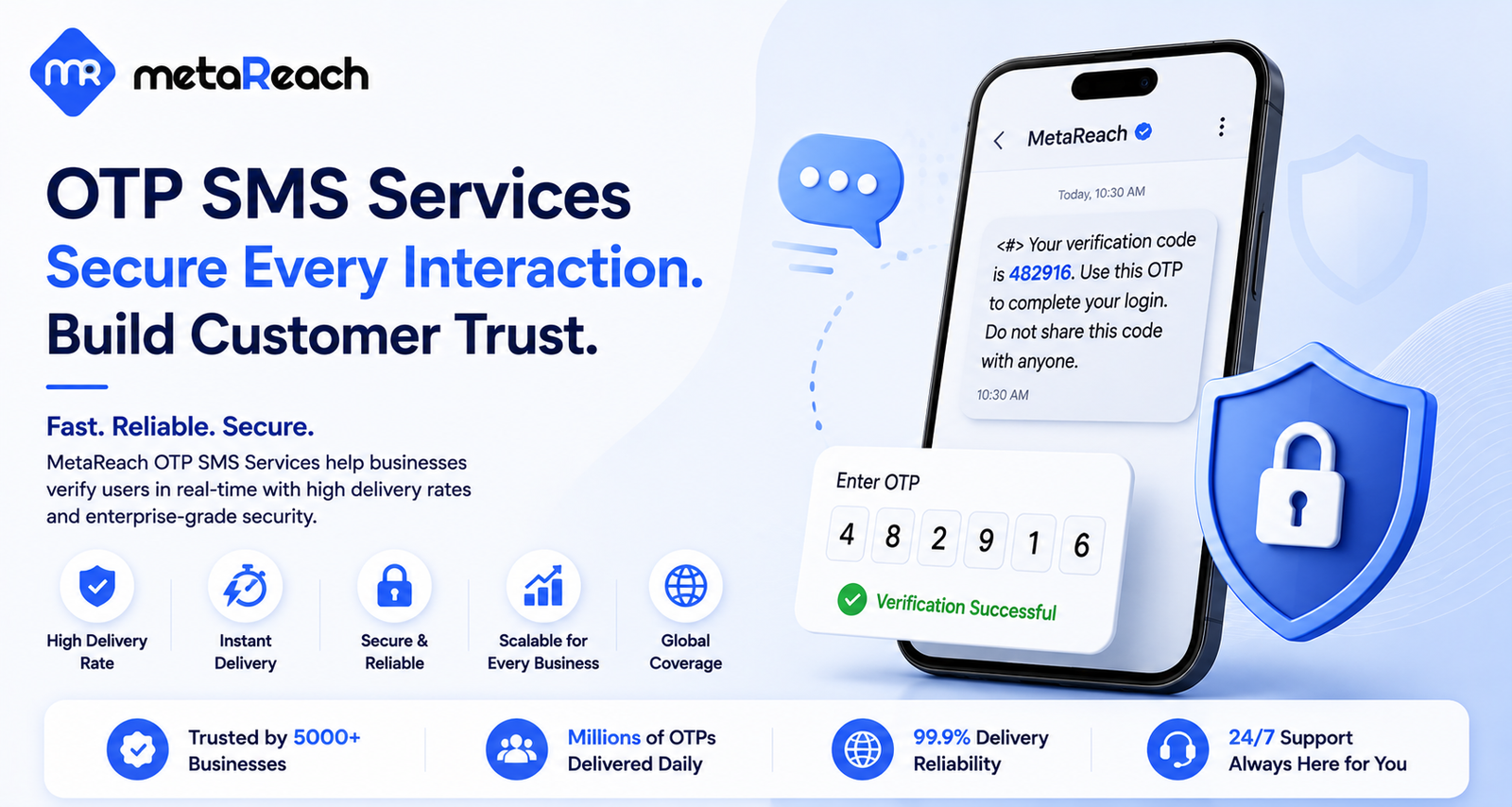
An OTP SMS is a short, auto-generated numeric code sent to a user’s registered mobile number to confirm they are who they claim to be. Unlike a static password, it expires after one use or after a short time window, which makes it far harder for anyone to intercept and reuse. This single mechanism now underpins two-factor authentication, payment approvals, account logins, and identity verification across banking, fintech, e-commerce, and healthcare platforms all over the country.
Why Speed and Reliability Aren’t Optional
The value of an OTP drops sharply the longer it takes to arrive. If a code takes fifteen or twenty seconds to show up, users assume the request failed, hit retry, or simply abandon the transaction altogether. That’s a real cost for any business — a lost signup, an abandoned cart, a failed login that turns into a support ticket. This is why OTP traffic needs to run on a dedicated route, separate from promotional SMS, so authentication messages are never stuck in a queue behind a marketing blast. A well-run OTP gateway routes messages directly through carrier connections, keeping delivery times in the single-digit seconds rather than leaving it to chance.
DND and Compliance — Why OTPs Get Special Treatment
In India, TRAI’s DLT (Distributed Ledger Technology) framework governs all commercial SMS, and businesses can’t skip this step regardless of what kind of message they’re sending. Promotional messages are restricted to certain hours and can’t reach numbers registered under DND. OTPs, however, are classified as transactional messages, which means they’re exempt from DND restrictions and can be sent any time of day or night. That distinction matters enormously for authentication flows — a user resetting a password at 2 a.m. still needs the code to arrive immediately, not the next morning.
Where OTP SMS Makes the Biggest Difference
Banking and fintech platforms lean on OTPs for login alerts, fund transfers, and transaction approvals, where a delayed code isn’t just inconvenient — it can trigger compliance issues. E-commerce and D2C brands use OTPs at checkout and account creation, and a slow code directly translates into cart abandonment. Healthcare platforms use OTPs to secure patient portals and confirm appointments, often for users in smaller towns where network conditions vary. Even logistics and supply chain operations rely on OTPs for driver verification and delivery confirmation, since a fraudulent handoff is far more expensive than the SMS that could have prevented it.
SMS Still Beats the Alternatives for This One Job
App-based authenticators and email-based codes both have their place, but SMS OTP remains the most universal option available in India. It works on feature phones, on 2G connections, and across every operator — no app download, no internet connection required. For a country with hundreds of millions of mobile users spanning every kind of device and network quality, that universality is exactly why SMS continues to be the default first channel for verification, even as richer channels like WhatsApp and RCS grow in popularity as backup options.
What to Look for in an OTP SMS Provider
Not all OTP services are built the same way, even if they look similar on a pricing page. The details that actually affect outcomes are dedicated OTP routing separate from bulk traffic, transparent per-message pricing without hidden monthly minimums, DLT registration handled on the provider’s side rather than left to the business, and a fallback channel — usually Voice OTP — for the rare cases when SMS delivery fails. MetaReach Marketing’s OTP SMS service covers exactly this combination, offering sub-5-second delivery on dedicated carrier routes, free DLT registration handled by their team, and automatic Voice OTP fallback when an SMS can’t get through — all built specifically for businesses that can’t afford authentication failures.
The Bottom Line
OTP SMS looks like a small, unremarkable piece of the user journey, but it sits at the intersection of security, trust, and conversion. A slow or unreliable OTP costs a business far more than the SMS itself — in abandoned signups, failed payments, and users who simply don’t come back. Getting this one message right, consistently and quickly, is one of the highest-leverage decisions a growing platform can make.
Businesses evaluating OTP providers, or looking to add complementary channels like Bulk SMS, WhatsApp Business API, or RCS Messaging to their communication stack, can explore the full range of services offered by Meta Reach Marketing, a Noida-based enterprise communication and digital marketing agency trusted by 500+ businesses across India.