Almost every business with more than a year of operations has one: a contact list of past leads, customers, and partners who opted in at some point and then never heard from the brand again in any meaningful way. It sits in a CRM export or a spreadsheet, technically owned, practically ignored. And that’s a genuine waste, because among all the digital channels a business can invest in, email consistently delivers the highest return — often cited around ₹36 for every rupee spent, well ahead of paid social or display advertising.
The reason so many businesses still underuse it comes down to one habit: treating email as an occasional blast instead of a structured, ongoing channel.
Why Most Email Campaigns Underperform
The single biggest reason open rates stay stuck around the industry average of 18 to 22 percent is simple: everyone on the list gets the exact same message, regardless of whether they’re a cold lead who downloaded one whitepaper or a loyal customer of three years. An offer that’s irrelevant to most recipients will get ignored no matter how well the subject line is written. Segmenting a list by industry, engagement level, or buying stage — even into just three or four groups — routinely lifts open rates well above that baseline, simply because the message finally matches the person reading it.
The second, quieter problem is technical rather than strategic: email sent without proper SPF, DKIM, and DMARC authentication gives inbox providers like Gmail and Outlook no reliable way to confirm the sender is legitimate. A meaningful share of that mail lands in spam or promotions before anyone even sees it — no amount of great copywriting fixes a deliverability problem at the infrastructure level.
B2B Email Needs a Different Playbook
For B2B companies — particularly the kind of IT services and SaaS businesses clustered in tech corridors like Noida’s Sector 62 and 63 — a single promotional email rarely moves a decision-maker. These buyers respond to sequenced, value-first communication: an initial awareness email, a relevant case study a few days later, a comparison guide, and eventually a low-pressure invitation to talk. Multi-touch drip sequences built this way routinely convert leads into meetings at meaningfully higher rates than one-off blasts, precisely because they respect how long and considered a B2B buying decision actually is.
This matters even more for companies selling into procurement-heavy organisations, where a single email rarely reaches the actual budget holder on the first attempt. A well-built sequence accounts for that reality — it keeps nurturing a lead through multiple stakeholders and multiple months, rather than assuming one good email will do all the work of a sales conversation.
What a Properly Run Program Looks Like
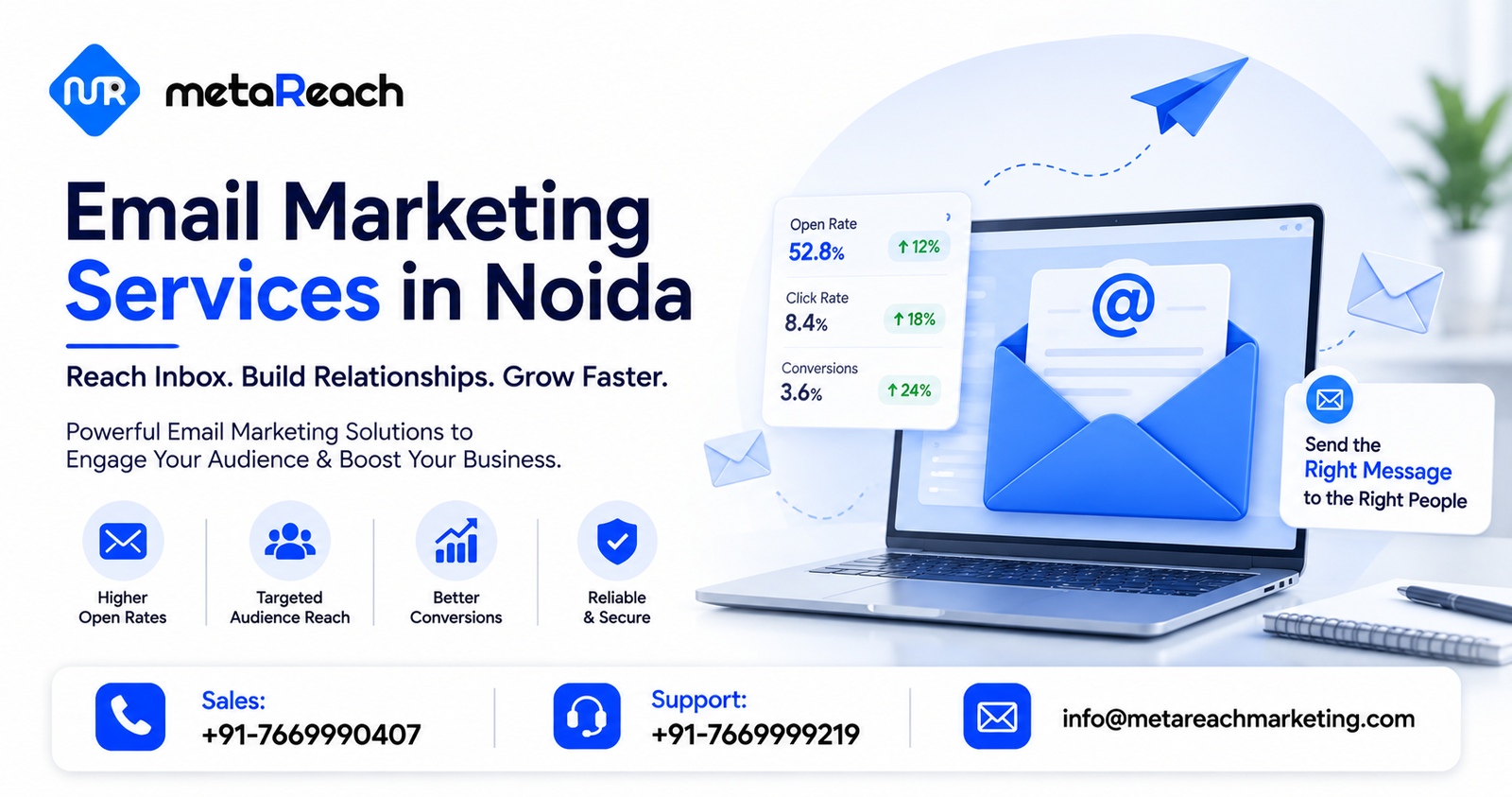
This detailed guide to email marketing services in Noida breaks down what a complete program actually involves — SMTP and domain authentication setup, list segmentation, automated drip sequences for onboarding and cart recovery, subject-line A/B testing, and monthly reporting that goes beyond just open rates. It’s a useful reference for understanding the difference between a DIY tool where you handle strategy yourself, and a managed service where segmentation, deliverability, and sequence design are handled as one connected system.
One detail worth paying attention to: automated workflows like welcome sequences, cart abandonment reminders, and re-engagement flows for dormant subscribers keep working around the clock once they’re built. A retail or e-commerce brand that sets up even a simple three-email cart recovery sequence — a friendly reminder, a follow-up with urgency, and a final offer — often recovers a meaningful share of revenue that would otherwise have been lost entirely, without a single extra hour of manual work each month.
Pairing Email With Other Channels
Email works even better when it isn’t running in isolation. Pairing it with SMS for time-sensitive alerts, or with WhatsApp for higher-engagement conversations, tends to outperform any single channel used alone — email carries the detailed content and nurturing, while faster channels handle the urgent nudges. Full-service providers like MetaReach Marketing, which runs email alongside bulk SMS, WhatsApp Business API, and broader digital marketing under one roof, are usually better positioned to coordinate that kind of cross-channel sequencing than a standalone email tool ever could, simply because the same team is planning both the email cadence and the surrounding channels together.
If your list has gone quiet, the fix rarely requires starting from zero. It usually starts with three unglamorous steps: authenticate your sending domain properly, split your list into a few meaningful segments, and build one automated sequence — even something as simple as a welcome series — before you send another one-off blast. Small, structural changes like these tend to move open rates and revenue far more than a cleverer subject line ever will.