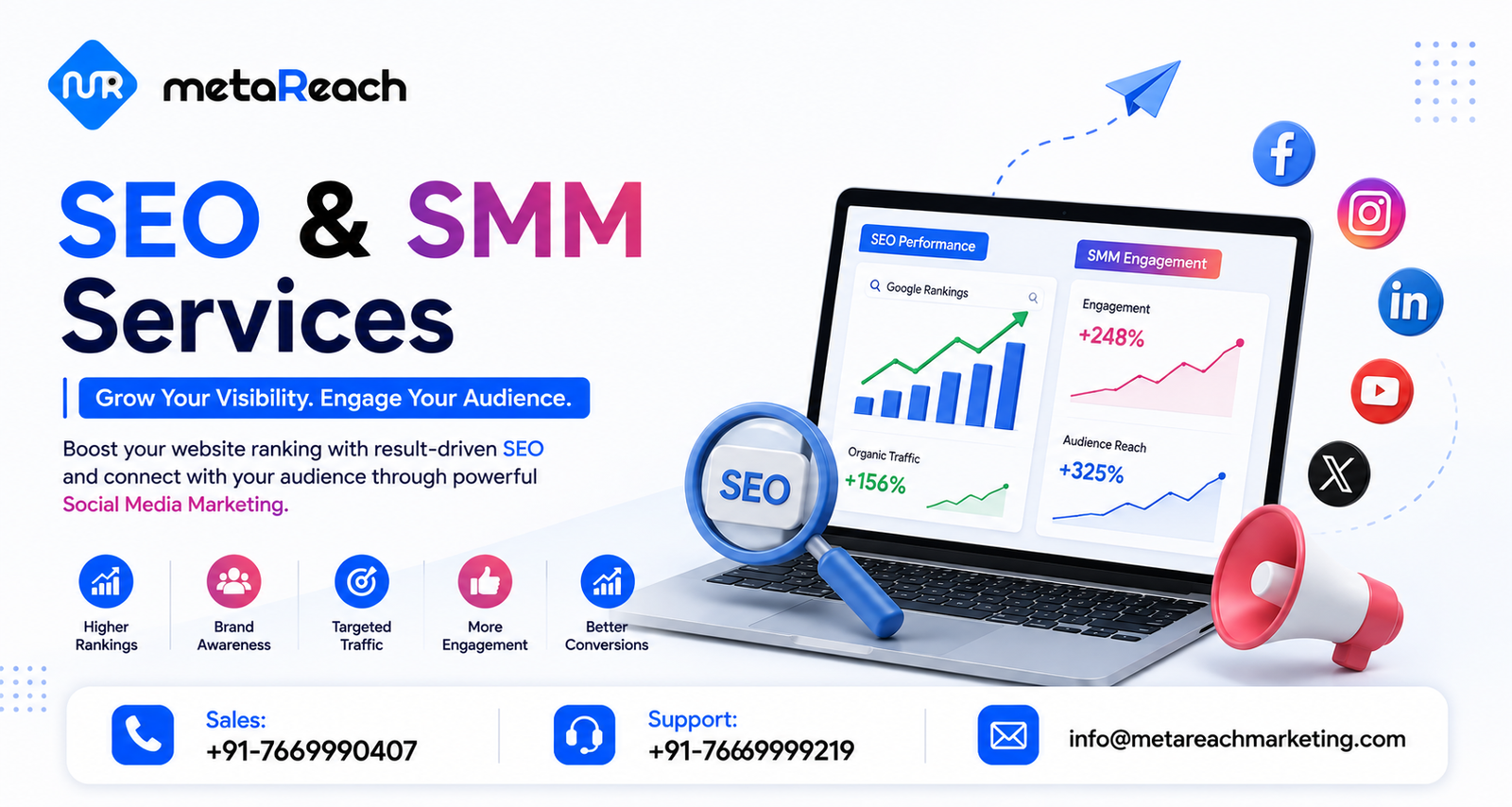
Most businesses in India still treat search engine optimisation and social media marketing as two completely separate line items — different vendors, different reports, sometimes even different internal teams. It’s an understandable habit; the two disciplines look different on the surface. One is about ranking on Google, the other about showing up in a scroll feed. But customers don’t experience a brand in silos, and the businesses seeing the strongest digital growth right now are the ones that stopped treating SEO and social as unrelated projects.
How the Two Channels Actually Reinforce Each Other
SEO captures people who already know what they want and are actively searching for it — someone typing “best CA firm in Sector 18” or “2BHK flats in Greater Noida West” has clear buying intent. Social media works earlier in that journey: it builds familiarity, trust, and recall before someone ever opens a search bar. When both channels share the same content foundation — a blog post that gets repurposed into a carousel, a case study that becomes a LinkedIn post, testimonials that appear on both the website and Instagram — each channel makes the other work harder. Search engines pick up on genuine engagement signals, and social audiences arrive at a website that already reflects the same voice and message they just saw in their feed.
Run separately, these same two channels often end up working against each other — inconsistent messaging, duplicated effort, and a marketing budget that never quite adds up to more than the sum of its parts.
What This Looks Like in Practice
Take a real estate developer trying to sell apartments in a competitive micro-market. SEO gets their project pages ranking for high-intent searches, but the sales cycle for a property purchase is long, and most visitors won’t convert on their first visit. That’s where a connected social presence matters — retargeting the same audience on Instagram and Facebook with project updates, site-visit videos, and testimonials keeps the brand visible during that entire consideration window, instead of losing the lead the moment they close the browser tab.
The same logic applies to a coaching institute chasing admissions, or a D2C fashion brand trying to turn engaged followers into repeat customers. In every one of these cases, the businesses getting real results are pairing organic search visibility with consistent, strategic social content, not choosing one over the other.
What an Integrated Strategy Should Include
A genuinely combined approach isn’t just running two separate campaigns under one invoice. It means a shared content calendar, keyword research that also informs social captions and hashtags, blog content that gets systematically repurposed into short-form video and carousels, and — critically — a single reporting dashboard so a business owner can see how search rankings and social engagement are moving together, not as two disconnected sets of numbers. This detailed breakdown of SEO and SMM services in India lays out exactly what that combined structure looks like, including how organic content strategy, paid social campaigns, and search optimisation are meant to work as one coordinated engine rather than three separate deliverables competing for the same budget.
What’s useful about seeing this laid out is the reminder that neither channel is optional for most businesses anymore. A brand with excellent Google rankings but no social presence looks outdated the moment a curious customer checks Instagram before buying. A brand with a large, engaged following but no search visibility is invisible the moment someone searches for what they actually sell instead of scrolling past an ad.
Choosing a Partner That Thinks in Systems, Not Silos
When evaluating an agency for this kind of work, it’s worth asking a simple question: do they report on SEO and social separately, or do they explain how the two are meant to feed each other? Full-service agencies that run SEO, social, paid ads, and content under one roof — like MetaReach Marketing, which manages campaigns for brands across Delhi NCR, Mumbai, Bangalore, Hyderabad, and Chennai — tend to naturally build that connective tissue into a strategy, simply because the same team is accountable for both outcomes instead of two vendors quietly pointing fingers at each other during a slow quarter.
Digital growth in India isn’t slowing down, and neither is competition for attention on Google or in the feed. Businesses that keep running SEO and social as two disconnected efforts will keep leaving easy wins on the table — the ones that connect the two will simply keep compounding, quarter after quarter.
The starting point doesn’t need to be complicated. Begin by auditing whether your current search content and social content even sound like the same brand, check if your top-performing blog posts have ever been turned into a single reel or carousel, and see whether your monthly reports actually connect the dots between the two channels or just list numbers side by side. Small alignment fixes here often surface quick wins before any new spend is even committed.