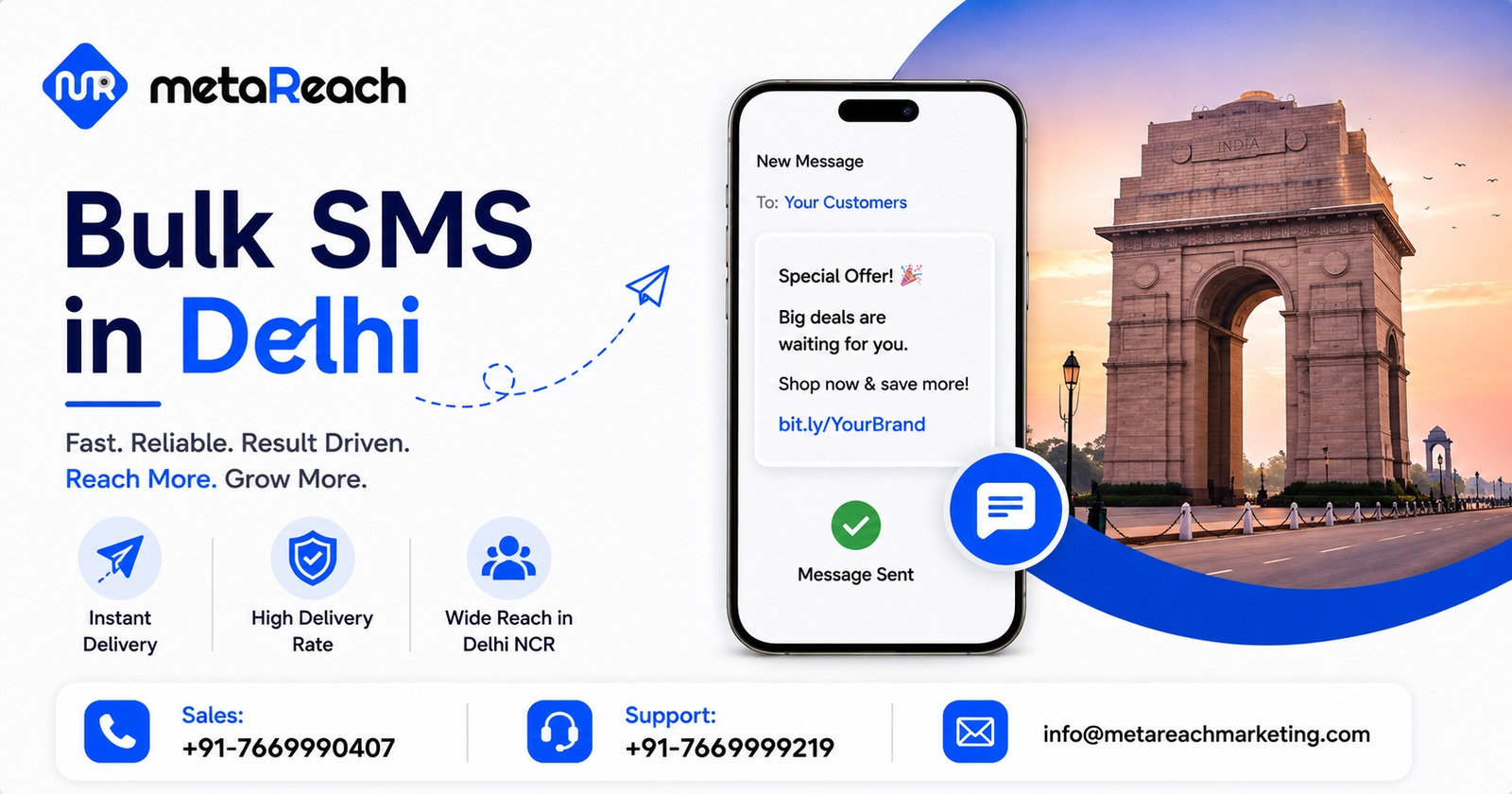
Every year someone declares SMS marketing dead, and every year Delhi NCR businesses quietly prove otherwise. Between WhatsApp campaigns, push notifications, and now RCS, it would be easy to assume a plain text message has lost its edge. It hasn’t. If anything, in a city as competitive as Delhi, bulk SMS has become the one channel businesses can rely on when everything else gets ignored.
The reason is simple: an SMS doesn’t need an app, an internet connection, or a customer’s attention span to work. It lands on the lock screen and gets read — usually within minutes. For a market like Delhi NCR, where customers range from South Delhi retail shoppers to Gurgaon corporate teams to Noida’s growing startup base, that kind of universal reach is hard to replace.
Why Delhi Businesses Keep Coming Back to SMS
Open rates tell most of the story. A well-sent SMS is read far more reliably than an email sitting in a promotions folder or a push notification swiped away without a glance. That single fact — that people actually see the message — is why real estate developers in Dwarka use it to fill weekend site visits, why clinics in Lajpat Nagar use it to cut down missed appointments, and why retail chains in Karol Bagh run their festive sale alerts through it instead of relying on social media alone.
It also works when nothing else does. Weak signal areas, older phones, customers who don’t have data left on their plan — SMS still gets through. That reliability matters more in a sprawling market like Delhi NCR than most businesses give it credit for.
The Part Most Businesses Get Wrong
The mistake isn’t choosing SMS — it’s treating every message the same way. Promotional offers, OTPs, and transactional alerts all need different delivery priorities and different compliance treatment under TRAI’s DLT framework. A flash-sale SMS sent through the wrong route can get filtered by DND rules, while an OTP that takes even 30 seconds too long can quietly cost a completed sale. Getting this routing right, and staying compliant with DLT registration in the process, is where most of the actual value gets lost or won.
Businesses evaluating a bulk SMS provider in Delhi NCR should look past the headline per-SMS rate and check three things instead: real delivery reporting (not just a “sent” status), how OTP routes are prioritised, and whether DLT registration is handled for you or left as your own paperwork problem. Those three details decide whether a campaign actually performs or just looks good on a quote.
Delivery Certainty Is the Real Differentiator
Ask most SMS users in Delhi about their biggest frustration and it isn’t price — it’s not knowing what actually happened after they hit send. A dashboard showing “delivered” means little if customers say otherwise. The providers worth using are the ones offering live, per-message delivery reports, so a business can see exactly who received a campaign and troubleshoot the ones who didn’t, instead of guessing.
That level of transparency is also what separates a vendor from a genuine communication partner — one that treats a missed OTP delivery as a real business problem, not just a support ticket.
Where SMS Fits Alongside WhatsApp and RCS
None of this means SMS should be the only channel. WhatsApp Business API and RCS both bring richer, more interactive messaging to customers who have the right app and internet connection. The smarter approach — and the one most Delhi NCR businesses are moving toward in 2026 — is running all three from one platform, so a campaign automatically reaches customers through the richest channel available to them, with SMS as the dependable fallback that guarantees nobody is missed.
Meta Reach Marketing is a Noida-based agency built around exactly this kind of unified messaging — bulk SMS, WhatsApp, RCS, IVR, and full digital marketing support for over 500 businesses across Delhi NCR and pan-India. Instead of juggling separate vendors and separate compliance headaches, businesses get one dashboard, one support line, and one team accountable for delivery.
Final Thought
SMS marketing in Delhi NCR isn’t old technology holding on out of habit — it’s still one of the few channels that reliably reaches every customer, on every device, regardless of internet or app installed. The businesses getting the most from it in 2026 aren’t the ones sending the most messages. They’re the ones who picked a provider that treats delivery, compliance, and reporting as seriously as the campaign itself.