If you run a business in India that sends order updates, login codes, or festive offers by text message, the per-SMS rate you’re quoted matters more than it seems. A difference of even three or four paise per message adds up fast once you’re sending tens of thousands of texts a month. Yet most businesses never actually compare providers side by side — they sign up with whoever their web developer recommended, or whoever answered the phone first, and end up paying well above the market rate for years without realising it.
The bulk SMS market in India isn’t small. Between OTP verification, delivery alerts, appointment reminders, and promotional blasts, businesses across e-commerce, banking, healthcare, education, and real estate rely on SMS as their most dependable channel — it doesn’t need an internet connection, it doesn’t get buried in a spam folder, and open rates are still dramatically higher than email. That reliability is exactly why pricing discipline matters. Overpaying for a commodity service eats into margins that could otherwise go toward customer acquisition or product development.
Why Rates Vary So Much Between Providers
Not all SMS gateways operate the same way. Some route messages through third-party aggregators, adding a margin at every hop. Others maintain direct connectivity with telecom operators, which cuts out the middlemen and passes the savings on. There’s also a real difference between promotional SMS (which is blocked for numbers registered under DND and can only be sent within specific daytime hours) and transactional or OTP SMS, which bypasses DND restrictions and needs to be delivered instantly, 24/7. Because OTP messages sit on priority routes, they’re almost always priced higher than promotional ones — but exactly how much higher depends entirely on the provider’s infrastructure.
Then there’s DLT registration — the TRAI-mandated process every business must complete before sending a single bulk message legally in India. It covers entity registration, sender ID approval, and template registration. The government’s own fee is fixed, but plenty of providers tack on a separate service charge just to help you complete the paperwork, and some skip helping altogether, leaving businesses to figure it out alone.
A Detailed 2026 Comparison, With the Numbers Laid Out
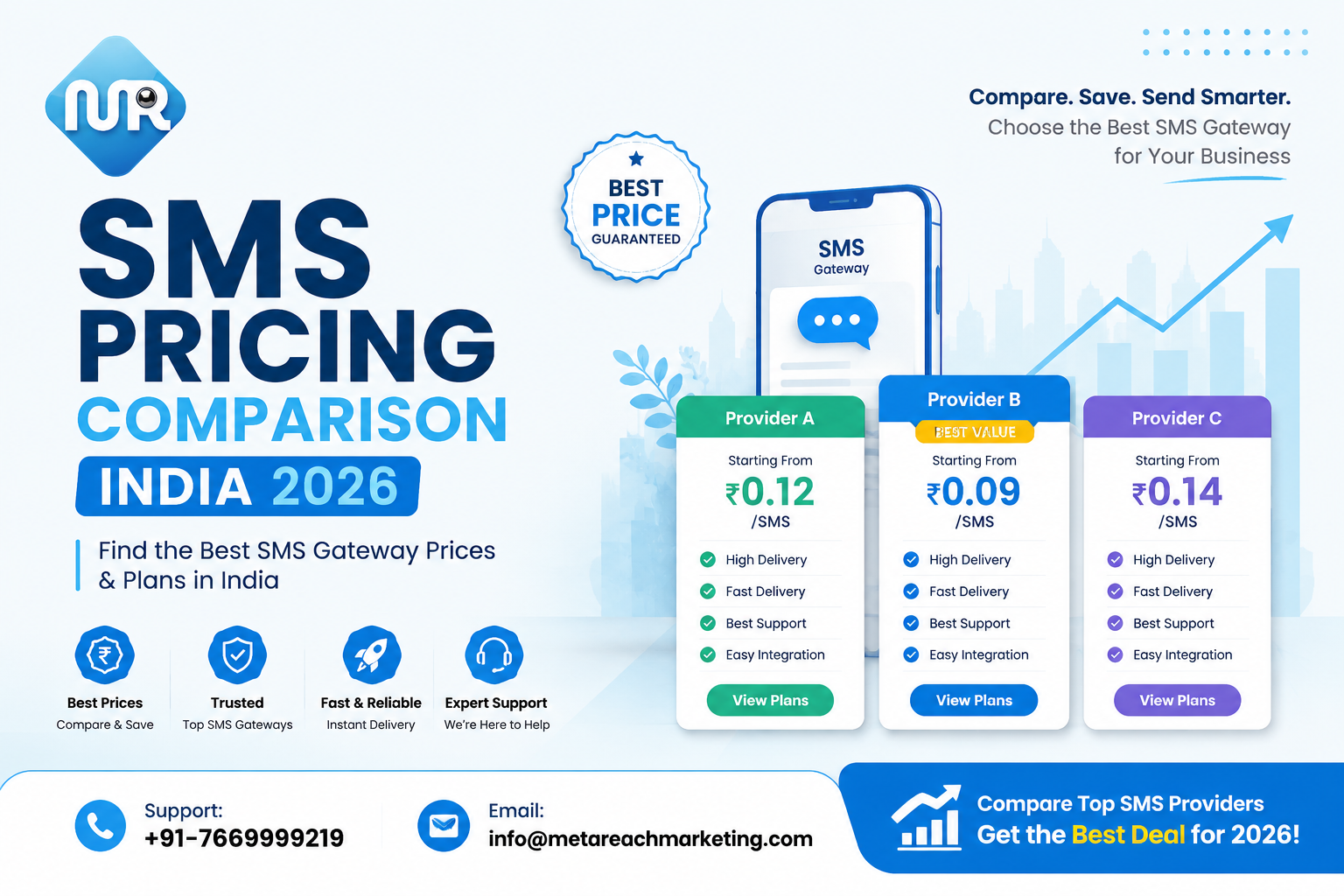
For anyone who wants the actual figures rather than vague claims of being “affordable,” MetaReach Marketing’s 2026 bulk SMS pricing comparison lays out per-SMS rates for promotional, transactional, and OTP messages across several well-known Indian providers, including Gupshup, Exotel, Route Mobile, and MSG91. Rather than a marketing pitch, it reads more like a spec sheet — a table of exact rupee figures, minimum volume requirements, setup fees, and support quality, plus a monthly cost breakdown that shows what the same 25,000 or 1 lakh SMS actually costs depending on who you choose. It’s the kind of resource worth bookmarking before you negotiate your next contract, because it gives you a real benchmark to hold any vendor’s quote against.
What stands out most in that breakdown is how much the gap widens as volume grows. At a few thousand messages a month, the difference between providers might only be a few hundred rupees — easy to ignore. But scale up to a few lakh messages, which isn’t unusual for a mid-sized e-commerce or fintech operation, and the same percentage gap turns into tens of thousands of rupees every single month. That’s a number worth putting in front of whoever owns the marketing or operations budget.
What to Actually Check Before You Commit
A low headline rate isn’t the whole story. Before signing anything, it’s worth confirming four things: whether DLT registration support is included or billed separately, whether there’s a minimum monthly volume you’re locked into, how the provider handles delivery during high-traffic periods like festive sales, and whether support is a real phone line or a ticket queue that takes days to respond. A provider that’s cheap on paper but slow to fix a delivery issue during a launch can cost far more in lost sales than it ever saved in per-SMS pricing.
It’s also worth checking whether the provider offers a proper API and dashboard as part of the base plan, rather than as a paid add-on. Most growing businesses eventually want to automate their messaging — triggering an OTP the moment a user signs up, or a delivery alert the moment an order ships — and retrofitting that later is far more painful than choosing a provider that supports it from day one.
For businesses based in or around Delhi NCR looking for a full-service partner rather than just a gateway, MetaReach Marketing also runs digital marketing, WhatsApp Business API, and IVR services alongside its SMS offering, which can be useful if you’d rather manage multiple communication channels under one roof instead of stitching together separate vendors for each one.
The Bottom Line
SMS pricing in India isn’t standardised, and providers rarely publish their full rate cards up front — you often only find out the real cost after a sales call. That makes independent, numbers-first comparisons genuinely useful, especially for smaller businesses that don’t have the leverage to negotiate enterprise discounts. Whatever provider you end up choosing, spend fifteen minutes checking actual per-SMS rates, DLT terms, and minimum volumes against a benchmark before you commit — it’s a small amount of time that can save a meaningful amount of money over a year.