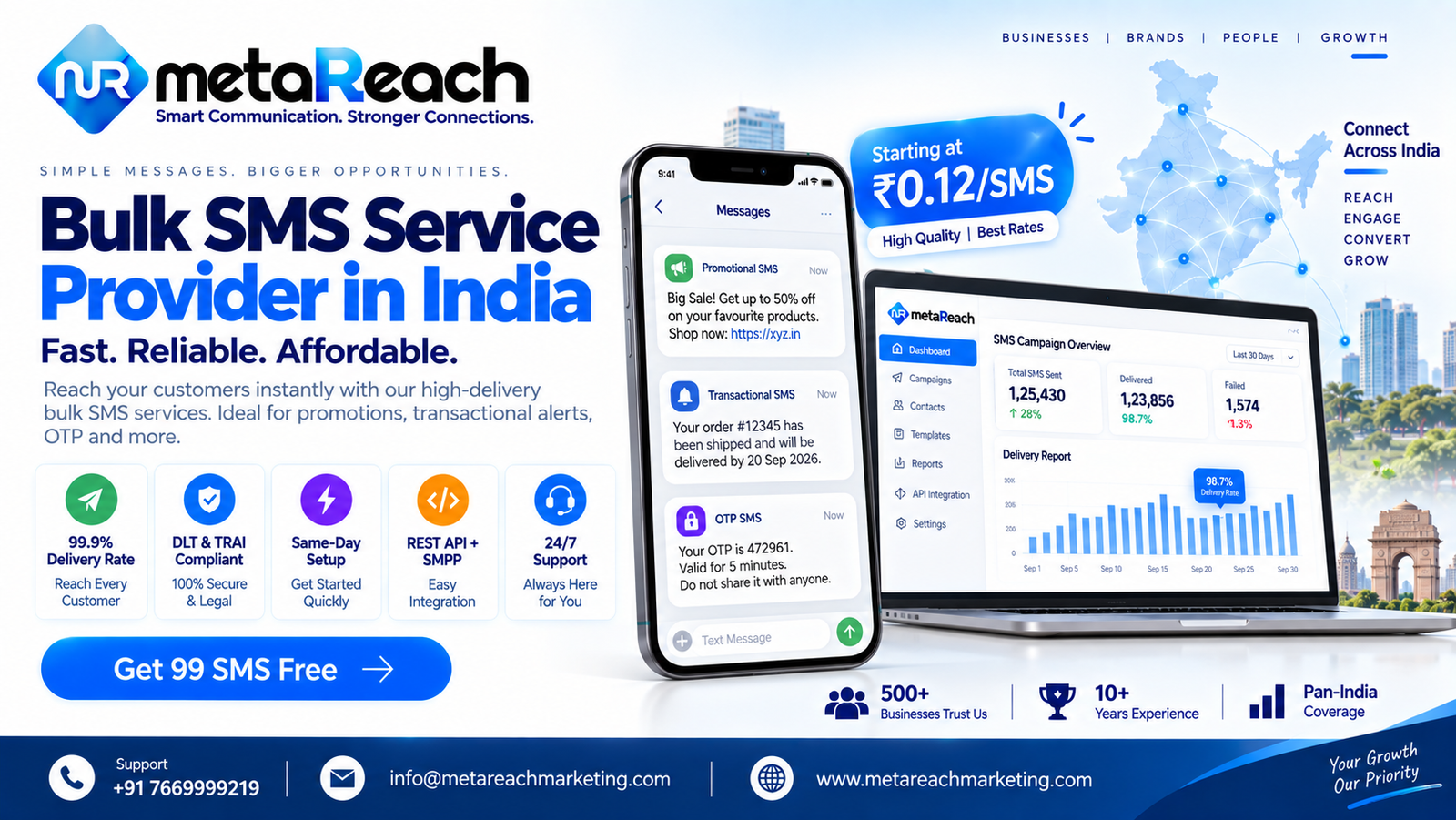
Ask ‘how much does an SMS cost’ and most providers will hedge with ‘it depends,’ which is technically true but not very useful when you are trying to put together a marketing budget. The honest answer is that bulk SMS in India generally lands in a tight band of a few paisa per message, with the exact figure shifting based on message type, sending volume, and how urgently the message needs to arrive. Once you understand the handful of variables that actually move the price, quoting and comparing providers becomes a much simpler exercise.
The Baseline Numbers Worth Anchoring To
As a general benchmark for the Indian market in 2026, promotional SMS tends to start around ten paisa per message at standard volumes, while transactional and OTP messages typically run a shade higher, close to eleven paisa, since they travel over priority delivery routes and reach DND-registered numbers around the clock. That gap of roughly one paisa reflects a real cost difference on the provider’s end, not just a pricing gimmick, because transactional traffic bypasses restrictions that promotional traffic is legally required to follow. GST at 18 percent sits on top of whichever base rate applies, so it is worth mentally adding that before comparing a final invoice against a quoted per-message rate.
These figures move meaningfully once volume enters the picture. A business sending a modest ten thousand messages a month will generally pay closer to the higher end of the promotional range, while a business committing to several lakh messages a month can often negotiate down toward the lower end of that band, sometimes further with a custom enterprise arrangement. This tiered structure exists because higher, more predictable volume genuinely lowers a provider’s per-message delivery cost, and well-run providers pass some of that saving back to the client rather than keeping the entire margin.
The One-Time Cost Almost Nobody Budgets For
Beyond the per-message rate, every business sending bulk SMS in India is legally required to complete DLT registration under TRAI regulations before a single promotional or transactional message can legally go out. This involves a fixed, one-time fee paid directly to the telecom operator, running into a few thousand rupees, plus GST. No SMS provider can waive this fee since it goes to the telecom operator rather than the provider itself, but providers differ enormously in whether they charge an additional service fee to help a business navigate the registration paperwork, or whether they absorb that effort as part of standard onboarding. This distinction is worth clarifying upfront, since a provider that quietly adds a service charge on top of the mandatory telecom fee can end up costing considerably more at the very first step, before any actual messages have even been sent.
Route Choice Changes the Price Too
Not all SMS routes are built the same. A direct route connecting straight to a major telecom operator typically delivers within a handful of seconds and carries a slightly higher per-message cost, while an aggregator route, which passes through an intermediary before reaching the operator network, tends to be cheaper but can introduce a small amount of extra latency. For promotional campaigns where a message arriving a few seconds later makes no real difference, the cheaper aggregator route is often perfectly reasonable. For OTPs and time-sensitive transactional alerts, though, that extra latency can be the difference between a completed login and an abandoned one, which is why reliable providers typically reserve direct operator routes specifically for that kind of urgent traffic even if it costs a little more.
How to Actually Compare Two Quotes
Rather than comparing two providers purely on their lowest advertised per-message figure, it helps to ask the same handful of questions of each: does the quoted rate already include GST or is that added separately, is DLT registration support included or billed on top, is there a minimum monthly volume required to unlock that rate, and which specific route is used for transactional versus promotional traffic. Two providers quoting an identical per-message rate can end up costing very different amounts once these details are accounted for, which is exactly why the lowest number on a sales call is rarely the full picture.
For an exact, up-to-date rate card covering promotional, transactional, OTP, and international SMS pricing at every volume tier, along with a full breakdown of what is and isn’t included in the quoted rate, this bulk SMS price page for India lays out current per-SMS rates, volume discount tiers, and DLT registration costs in detail.
Working Out What You’ll Actually Pay Each Month
A workable way to estimate a realistic monthly SMS bill is to separate your expected sending into its categories — promotional, transactional, OTP — multiply each by its respective rate, add GST on top, and then account for the one-time DLT fee only in the very first month. For most small and mid-sized businesses starting out, a sending volume in the range of ten thousand to one lakh messages a month keeps the total bill modest and predictable, while high-volume senders should push for a negotiated enterprise rate rather than accepting a standard published tier that was never designed with their scale in mind.
Businesses across India looking for transparent, no-setup-fee bulk SMS pricing with DLT registration handled at no extra cost can explore what MetaReach Marketing offers across promotional, transactional, and OTP SMS plans. Understanding exactly what moves the per-message rate up or down makes it far easier to negotiate confidently and budget accurately as sending volume grows.