Plenty of businesses build a great SMS campaign — solid offer, clean copy, sizable contact list — and still watch it fail completely, not because of anything wrong with the message itself, but because the sender was never properly registered. DLT registration India is the regulatory layer that determines whether a commercial SMS reaches a phone at all, and skipping it, or getting it wrong, is one of the most common and most avoidable reasons campaigns silently underperform.
What DLT Registration Actually Is
DLT stands for Distributed Ledger Technology, and it is the TRAI-mandated platform that governs every commercial SMS sent in India. The system was built to curb spam, fraud and unauthorised use of brand identity by requiring every business to register its identity, its sender headers, and its exact message templates before any of it can be sent to a customer. Once a business completes TRAI DLT registration, every approved template gets a unique ID that has to be embedded in the message itself, and telecom operators check this ID before allowing the SMS through their network.
Why This Isn’t Optional, Even for Small Senders
There is a persistent myth that DLT registration only matters for large enterprises sending lakhs of messages a month. In reality, the requirement applies to every business sending commercial SMS in India, regardless of volume. A clinic sending appointment reminders to thirty patients a week needs DLT registration for bulk SMS just as much as an e-commerce brand sending OTPs to a million customers. The consequence of skipping it is identical at any scale: messages get blocked at the operator level before they ever reach the recipient, and the business has no visibility into why its campaign quietly failed.
The Three-Step Process, in Plain Terms
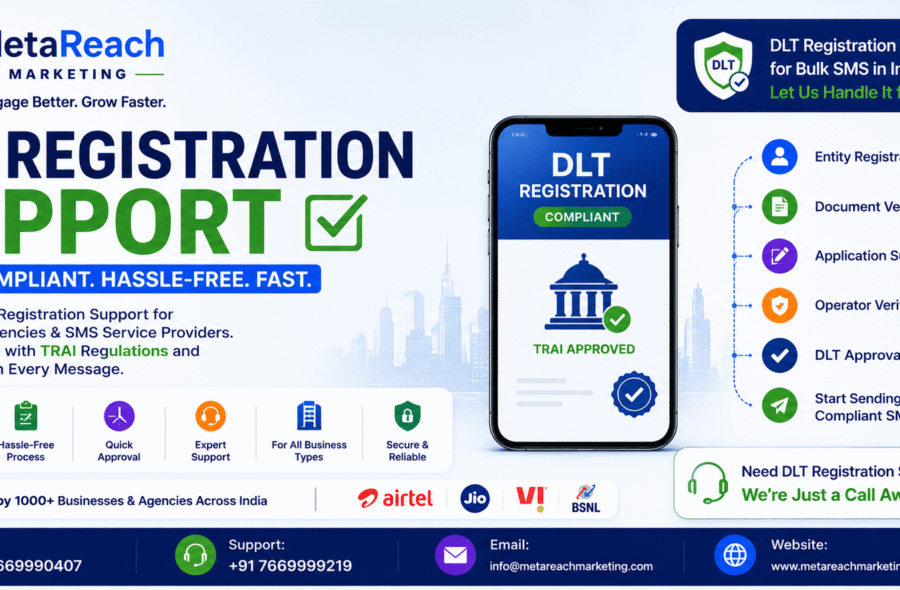
- Entity registration — your business registers on a telecom operator’s DLT platform and receives a Principal Entity ID (PE ID), the foundational identity every other step depends on.
- Sender ID registration — a six-character alphanumeric header gets registered and categorized as transactional, promotional, or service, and this is what appears as the sender name on every message.
- Template registration — every individual SMS template is submitted, reviewed for category accuracy and correct variable formatting, and issued its own template ID that must be included in every message sent using it.
Where Most Businesses Get Stuck
The registration steps themselves are not technically difficult, but they are easy to get wrong in ways that cause real delays. Mismatched categories — registering a marketing message under a transactional template, for instance — get rejected outright, since TRAI’s review system checks category consistency carefully. Incorrect variable formatting, missing sample values, and forgetting to update the approved PE ID inside your SMS gateway configuration are equally common, and each one can add days or weeks to a process that should otherwise move quickly. Most of these mistakes only surface after a rejection, by which point the campaign timeline has already slipped.
Why Professional Support Changes the Timeline
Done correctly with all documentation prepared upfront, the full registration process typically takes under two weeks. Done without guidance, it frequently stretches into a month or more, mostly due to repeated correction cycles on rejected templates. This is the real value of working with a provider that specialises in DLT registration support — not just submitting forms on your behalf, but reviewing documents and template formatting before submission so the common rejection triggers never happen in the first place.
What Good DLT Support Should Include
A genuinely useful DLT support service should handle entity registration, sender ID approval, and template registration as one coordinated process across the telecom operators relevant to your customer base, rather than treating each operator as a separate, disconnected task. It should also stay current with TRAI’s evolving guidelines, since rules around template formatting and compliance checks do get revised periodically, and a provider that isn’t tracking these changes can submit a template that was compliant six months ago but gets rejected today.
The Bottom Line
DLT registration for bulk SMS is not a bureaucratic formality that can be deprioritised — it is the gatekeeping layer that determines whether your messages are delivered at all. Getting it right the first time, with correctly categorised templates and properly formatted variables, saves weeks of avoidable delay. Agencies such as MetaReach Marketing that handle DLT compliance as a core, ongoing part of their SMS service tend to catch these issues before submission rather than after a rejection, which is usually the difference between a campaign that launches on schedule and one stuck in a correction loop.