Ways to cut Monthly Expenses: A data-backed guide for Indian households looking to spend smarter, save more, and actually enjoy the process
Picture this: It’s the 28th of the month. Your salary hit the bank exactly four weeks ago — and somehow, you’re already refreshing your UPI balance every few hours wondering where it all went.
Zomato, two Swiggy runs, a Netflix subscription you upgraded mid-month, three “flash sale” impulse buys on Meesho, and a surprise birthday dinner at a restaurant that charged ₹800 per head. None of these felt big in the moment. Together, they quietly swallowed a third of your income.
Sound familiar? You’re not alone — and you’re not bad with money. You’re just living in 2026 India, where spending has never been easier or more invisible.
This guide isn’t about extreme frugality or giving up chai. It’s about 10 research-backed strategies tailored to the Indian context that will help you cut unnecessary expenses, redirect money toward things that genuinely matter to you, and feel financially confident before the month ends.
Manage Your Budget Better with the Ultimate Expense Tracker App.
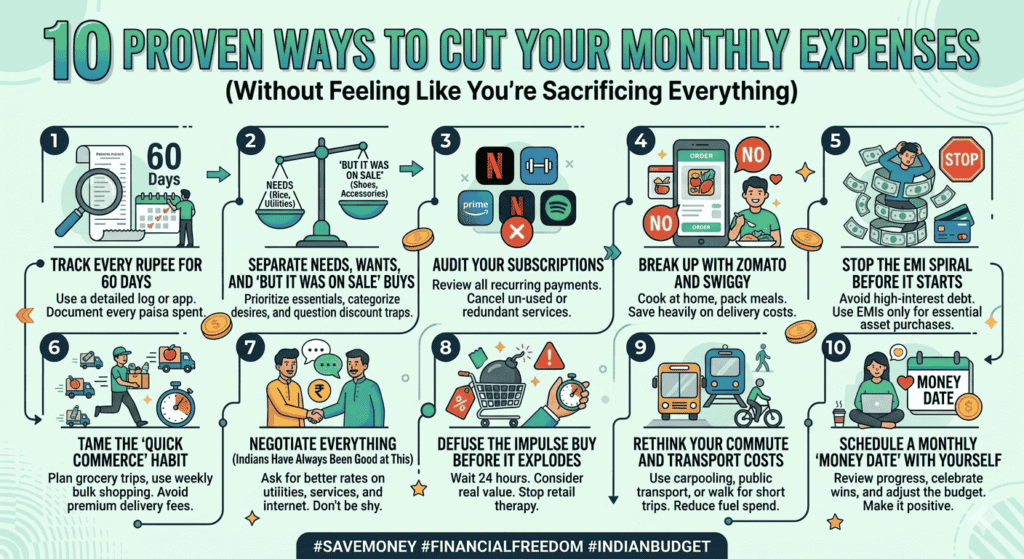
10 Ways to Reduce Your Expenses — Starting Today
1. Track Every Rupee for 60 Days (Yes, Every Single One)
Most Indians seriously underestimate how much they spend. We mentally round down on Swiggy orders, forget the auto-renewing Amazon Prime, and never count those “small” UPI transfers to friends that never got paid back.
Research published in ResearchGate (2024) found that tracking expenses consistently improves both financial awareness and confidence. The act of recording a purchase makes you pause and ask: “Do I actually want this?”
How to do it in India:
- Use apps like Wallet by BudgetBakers, Spendee, or even the native spending reports inside Google Pay or PhonePe
- Download your bank statement at month-end and sort by category using a simple Excel sheet
- Commit to at least 60 days — two months reveals seasonal and habitual patterns that one month hides
2. Separate Needs, Wants, and ‘But It Was on Sale’ Buys
Rent, groceries, school fees, electricity — these are non-negotiable. But the line between “need” and “want” gets dangerously blurry in urban India. A gym membership might feel essential; that fourth streaming platform subscription almost certainly isn’t.
A useful framework: for every discretionary expense, ask “Does this align with my top three life priorities?” If yes, budget for it joyfully. If no, it’s a candidate for the chopping block.
Values-based budgeting has been shown to reduce spending guilt and increase satisfaction with purchasing decisions — meaning you can spend on things that genuinely matter without the after-guilt spiral.
3. Audit Your Subscriptions (The ₸100 Trap)
India now has 148.2 million active paid OTT subscriptions, many of them sitting forgotten on auto-renewal. Add in music apps, cloud storage, news apps, productivity tools, and gym memberships — and most urban households are bleeding anywhere between ₹1,500 and ₹5,000 every month in subscriptions they barely use.
Action Plan:
- Search your email for “subscription” and “renewal” to find every active service
- Check your bank statements for recurring charges you’ve stopped noticing
- Rotate OTT subscriptions: watch one platform for two months, pause it, switch to another
- Share family plans wherever possible — Spotify, YouTube Premium, and Apple One all offer legitimate family tiers
- Cancel anything you haven’t used in the past 30 days — you can always resubscribe
4. Break Up with Zomato and Swiggy (At Least a Little)
India’s food delivery market hit $30.81 billion in FY2024 and is barreling toward $120 billion by 2032. The average food delivery order in a metro city costs between ₹350 and ₹700, with platform fees, surge pricing, and packaging charges piling on top. Cook the same meal at home and you’re looking at ₹80–150.
That’s not a judgment — it’s math. Even cutting delivery from daily to three times a week can save ₹2,000–4,000 a month for a couple in a Tier-1 city.
Practical swaps:
- Batch-cook on Sunday evenings to reduce weekday fatigue that triggers delivery impulses
- Keep a “meal emergency kit” — eggs, bread, dal, frozen roti — for days you’re too tired to cook
- If you do order, skip the “Pro” membership if you order fewer than 8 times a month — you’re likely paying more for the plan than you’re saving
5. Stop the EMI Spiral Before It Starts
India’s “No Cost EMI” culture is brilliant marketing and dangerous budgeting. When everything from a ₹12,000 phone to a ₹3,000 air fryer is available in easy monthly installments, it’s easy to stack 6–10 EMIs without realising you’ve committed a third of your monthly income to payments before you’ve even paid rent.
The rule of thumb: your total monthly EMI obligations should not exceed 35–40% of your take-home income. If you’re past that threshold, stop adding new EMIs immediately and consider prepaying the smallest ones first to free up cash flow.
And beware credit card minimum payments — rolling over a ₹50,000 balance at 36–42% annual interest (common in India) means you could end up paying back nearly double over two years.
6. Tame the ‘Quick Commerce’ Habit
Blinkit, Zepto, and Swiggy Instamart have made 10-minute grocery delivery mainstream. This is a convenience revolution with a hidden cost: the premium pricing on these platforms (typically 15–30% higher than neighbourhood kiranas), plus the encouragement to buy in small, frequent bursts rather than planned, bulk purchases.
A family doing daily Blinkit runs instead of a weekly planned grocery shop at a supermarket or kirana can easily overspend by ₹3,000–5,000 a month on the same basket of goods.
The fix: write a weekly grocery list, shop once or twice a week, and treat quick-commerce apps as an emergency backup — not a default.
7. Negotiate Everything (Indians Have Always Been Good at This)
Haggling at Sarojini Nagar is cultural. So why don’t we do it for our internet plans, insurance premiums, and mobile recharges?
Bills worth negotiating or switching:
- Broadband/WiFi: Call your provider and ask for a retention offer. Most give 3–6 months of free speed upgrades to prevent churn
- Mobile recharge: Compare Jio, Airtel, and BSNL plans annually — loyalty rarely pays on telecom
- Car and bike insurance: Use aggregators like PolicyBazaar to compare on renewal instead of auto-renewing with the same insurer
- Society maintenance: Understand what you’re paying for and raise objections if services aren’t being delivered
8. Defuse the Impulse Buy Before It Explodes
Big sale events — Amazon’s Great Indian Festival, Flipkart’s Big Billion Days, Myntra’s End of Reason Sale — are engineered to bypass your rational brain. Countdown timers, “Only 2 left!” banners, and notifications from influencers you follow are all designed to collapse the time between desire and purchase.
The 48-hour rule is your best defence: add the item to your cart, then wait two full days. You’ll be surprised how many “must-haves” you quietly forgot about.
Other impulse-blocking tactics:
- Unsubscribe from all retail promotional emails (use Unsubscribe.io or do it manually)
- Delete saved card details from shopping apps — friction is your friend
- Set a monthly “fun money” budget — guilt-free spending within that limit prevents the all-or-nothing mindset that leads to binges
9. Rethink Your Commute and Transport Costs
Conveyance is now one of the top non-food expenses in urban Indian households, according to MoSPI’s HCES 2023–24 data. Between Ola/Uber surge pricing, petrol costs, parking fees, and the temptation to “just take a cab,” transport can easily consume ₹8,000–15,000/month for city-dwellers.
Cost-cutting ideas that don’t require a lifestyle sacrifice:
- Carpool with colleagues using WhatsApp groups — split costs 4 ways and save 75%
- Use metro + last-mile e-bike combo (companies like Yulu and Bounce are cheap in most metro cities)
- Negotiate WFH days if your role allows it — even two days a week cuts your commute cost by 40%
- Reserve cabs for late nights or emergencies; use BMTC, DTC, or BEST for daily commutes where safe and feasible
10. Schedule a Monthly ‘Money Date’ with Yourself
Expenses creep. The gym you stopped going to still charges you. The broadband plan you outgrew three years ago still auto-renews. Life changes — your budget should too.
Set a recurring calendar reminder on the 1st of every month. Make a cup of chai, open your bank statement, and spend 30 minutes reviewing: What did I spend? What surprised me? What do I want to do differently? Track your net worth — assets minus liabilities — as your north star metric. It should grow every month.
This isn’t about punishment. It’s about staying in the driver’s seat of your own financial life. Manage Your Budget Better with the Ultimate Best Expense Tracker Apps in India 2026.
The Bottom Line
Cutting expenses doesn’t mean living less. It means living more intentionally. India’s middle class is growing fast — disposable incomes are rising, digital spending is exploding, and the pressure to keep up is relentless. But the people who build real wealth aren’t the ones who earn the most. They’re the ones who decided, at some point, to stop spending unconsciously.
Start with one tip from this list. Just one. Track your spending for a week. Cancel one subscription you don’t use. Cook dinner instead of ordering it twice next week. These feel tiny. Over 12 months, they compound into tens of thousands of rupees — and more importantly, into a version of yourself who is genuinely in charge of their money.
That’s the goal. Not to live less. To live better.